In my last post I shared about The Trust Hinge and how it connects the Wall of Character and the Door of Opportunity in our relationshipsLike a door hinge, trust hangs on the firm, established wall of character. And when we act with character in a trustworthy manner, doors of opportunity swing open in our relationships.

So that raises a question: What do you do when you’ve lost trust in a relationship? Whether you’ve broken trust, or someone has broken your trust, it always comes down to two things: BEHAVIOR and INSECURITY.

When somebody doesn’t trust you, it’s because they’re wrestling with your behavior or their insecurity. I can correct my behavior and my insecurity, but I cannot correct your behavior or your insecurity. Everybody has to own their behaviors and their insecurities without taking the blame for somebody else’s shortcomings. When you don’t take ownership, you will always break trust. And when you take the blame for somebody else’s behavior and insecurities, you’re allowing them to take advantage of your value and vulnerability.

It’s not easy to repair or restore trust, but at the end of the day you have to take two steps to begin the process:

  • Correct your behavior consistently over time - Notice I said, “consistently over time.” Anybody can do the right thing once. But trust is only established when there’s a pattern of consistent, credible, and reliable character and integrity. Furthermore, the timetable for the restoration of trust is always determined by the person who was hurt in the relationship. They get to decide when they’re willing to trust again. That’s why hit and miss attempts at character will only reinforce your behavior gaps and lengthen the healing process.
  • Address your own insecurities - What insecurities in your life make you unwilling to trust others? Have you been hurt in the past and now you live life with a guard around your heart? Is it your addiction to others’ approval that causes you to become vulnerable? How you respond to your insecurities will dictate your level of trust in your relationships. When you are secure in who you are, you tend to value yourself and others because you view one another as made in the image of God.

As you take these steps, you’ll demonstrate how much you value the relationship and you’ll act in a trustworthy manner toward others and toward yourself.

Question: What other tips would you offer to restore trust in a relationship?

Our world is becoming increasingly social through incredible tools such as Facebook, Twitter, Google+, Pinterest, and countless others. All of these tools have tremendous value, and I believe they are great resources to expand, and even enrich, our social connections.

But for social connections to thrive, we must add foundational truths to the tools that enable social connections. Tools minus truths equals dysfunction. You enrich your relationships with tools but you establish your relationships on truths.

So what truth is at the core of healthy relationships? Whether it’s your spouse, kids, fiance, boyfriend, girlfriend, best friend, co-workers, or employer, I believe The Trust Hinge is the first key to healthy relationships.

Trust implies leaning on, confiding in, and being certain. In Scripture, trust is a picture of support and security. It’s something that grows over time and results in confidence and influence. So what exactly is “The Trust Hinge?”

In Titus 2, the apostle Paul describes a relationship between Christian slaves and their masters. In our context today, we could also apply this passage to the relationship between employers and employees. Paul writes:

Teach slaves to be subject to their masters in everything, to try to please them, not to talk back to them, and not to steal from them, but to show that they can be fully trusted, so that in every way they will make the teaching about God our Savior attractive. (Titus 2:9-10)

These two verses are hinged around a powerful statement: “…but to show that they can be fully trusted.” Trust is the hinge on which healthy relationships swing. A hinge links two things together. In the case of a door hinge, one part of the hinge is connected to the wall. The wall is firm, established, and immovable. But the other part of the hinge is connected to the door. Doors open…they lead you to new opportunities. In this passage, we learn a core truth about relationships:

Trust is the Relational Hinge Between the Wall of Character and the Door of Opportunity

On one side of the Trust Hinge is the “Wall of Character.” Paul describes this wall of character when he instructs slaves to demonstrate character in three primary ways:

  • Serve their employer with their employer’s interests in mind
  • Speak to their employer with the proper attitude
  • Steward their employer’s resources with integrity

When employees do these things, they will “show that they can be fully trusted.” In other words, firm character is the wall on which relational trust hangs. Paul is saying, “Trustworthy behavior produces trust in relationships” and he’s implying that untrustworthy behavior produces distrust in relationships.

Not having trust is like walking in the dark. If you get out of bed in the middle of the night, and you’re trying to see your way around, your trust is immediately circumvented by uncertainty and suspicion. Why? Because you can’t see reality clearly. The same is true in relationships. When the relationship is shadowed by character flaws, suspicion and uncertainty circumvent the relationship. 

In his book The DNA of Relationships, Dr. Gary Smalley makes a powerful observation about being trustworthy with others, and being trustworthy with ourselves. He says:

“When you are trustworthy with others, you dedicate yourself to treating them as the valuable and vulnerable people that they are. When you are trustworthy with yourself, you act in ways consistent with your own value and vulnerability” (p. 81)

When you’re trustworthy with others, you don’t take advantage of them because you recognize them as valuable human beings and as vulnerable people. You see them the way God sees them and thus act in a trustworthy manner toward them. When you’re trustworthy with yourself, you act in a way that expresses your personal value and vulnerability. You stand up for the value God has placed on you rather than letting others take advantage of your vulnerability. 

Seeing people, and yourself, as valuable and vulnerable requires character and integrity. Without it, the Trust Hinge has nothing firm to hang onto.

On the other side of the Trust Hinge is the “Door of Opportunity.” Titus 2:10b says, “…but to show that they can be fully trusted, so that in every way they will make the teaching about God our Savior attractive.”

The word translated “attractive” means to “adorn.” It’s the idea of arranging jewels in a manner that sets off their beauty. When you go to a jewelry store to look at diamond rings, the light is perfect and the rings are carefully arranged in the display case. In other words, they are made to look their very best.

Paul is suggesting that when we act with character in a trustworthy manner, it’s like arranging the teachings of God to look the most beautiful. In the case of Titus 2, Paul was saying to slaves, “When you act with trustworthy character toward your masters, the door for representing the Gospel swings open.” The same principle is true for us today. When we act with trustworthy character, it opens the door of opportunity. How?

  • When you act with trustworthy character in your marriage, the door of a love-filled marriage swings open.
  • When you act with trustworthy character toward your boss, the door of raises and praises swings open.
  • When you act with trustworthy character toward your friends, the door of fun-filled memories swings open.
  • When you act with trustworthy character toward your co-workers, the door of camaraderie and cooperation swings open.
  • When you act with trustworthy character toward your parents, the door of greater freedom swings open.

Remember, Trust is the Relational Hinge Between the Wall of Character and the Door of Opportunity

All of us want the open doors, but the question is, “Are we willing to address the character deficiencies in our lives that prevent those doors from opening?”

  • When doors of love and joy are not opening in your marriage, what character deficiencies are you willing to address in your life?
  • When the doors of praises and raises are not opening on your job, what character deficiencies are you willing to address in your work ethic?
  • When the doors of fun-filled memories are not opening with your friends, what character deficiencies are you willing to address in who you are as a friend?
  • When the doors of camaraderie and cooperation are not opening with your co-workers, what character deficiencies are you willing to address in how you work?
  • When the doors of freedom are not opening with your parents, what character deficiencies are you willing to address in honoring and obeying your parents?

Healthy relationships require trust. When The Trust Hinge has a Wall of Character to firmly connect to in your life, doors of opportunity are more likely to swing open.

Question: How have you seen the “Trust Hinge” work in life, leadership, and relationships? 


Churches tend to lag behind when it comes to innovation. Pastors are usually so focused on “Sunday’s Coming” that they forget the future is already here. As a result, churches spend most of their time living in the past, planning for today, and completely missing tomorrow.

But what if you could actually shape the future. What if, rather than living in reaction mode, you actually created the future. Irene Sanders, innovator and author of Strategic Thinking and the New Science, observes, “The key to influencing the future is to apply your thinking and planning resources NOW to emerging conditions, issues, and opportunities.” Doing so requires a blend of insight about the present and foresight about the future.

Insight comes from studying the issue or problem at hand, understanding your church’s history, knowing the assumptions that shape why and how you do ministry, and reading and learning outside of your field. This aggressive learning posture prepares you to see and seize the future.

Foresight is all about identifying your emerging initial conditions. I know that’s a mouthful so let me make it as plain as I can with application to a local church. Identifying your emerging initial conditions is about seeing the changes that are bubbling below the surface of your church that could have a radical impact on how you do ministry. These conditions are usually not easily visible. They could be emerging changes in the community where you serve, emerging technologies, economic shifts, growing needs, or any number of issues. Sanders says, “These are things which  may seem small now, but if any one of them mushroomed overnight it could have a dramatic impact on the future of your business.”

Continue Reading…

I can still remember reading John Maxwell’s early leadership book, Developing the Leader Within You, and thinking, “This is the best leadership book I’ve ever read.” Suddenly it occurred to me: “This is the only leadership book I’ve ever read.”

For years, personal growth wasn’t anywhere on my radar. I hated reading and throughout most of college, I only cracked half my textbooks (nothing like spending dad’s money to buy books you never read). Turns out, I wasn’t alone. Only 45% of Americans over the age of 13 read a book in the course of a year.

After graduating college with all the answers, it took me a couple of years to realize how little I actually knew. Eric Hoffer’s words described me well:

“In times of profound change, the learners inherit the earth, while the learned find themselves beautifully equipped to deal with a world that no longer exists.”

I was well-prepared for irrelevance. That newfound humility forced me into a learning mode. In the years that followed—mostly out of necessity—I developed a habit of reading. But more importantly, I stumbled upon five practices of personal growth that transformed my life. The first three practices maximize growth within us and the last two practices leverage growth in the people we influence.

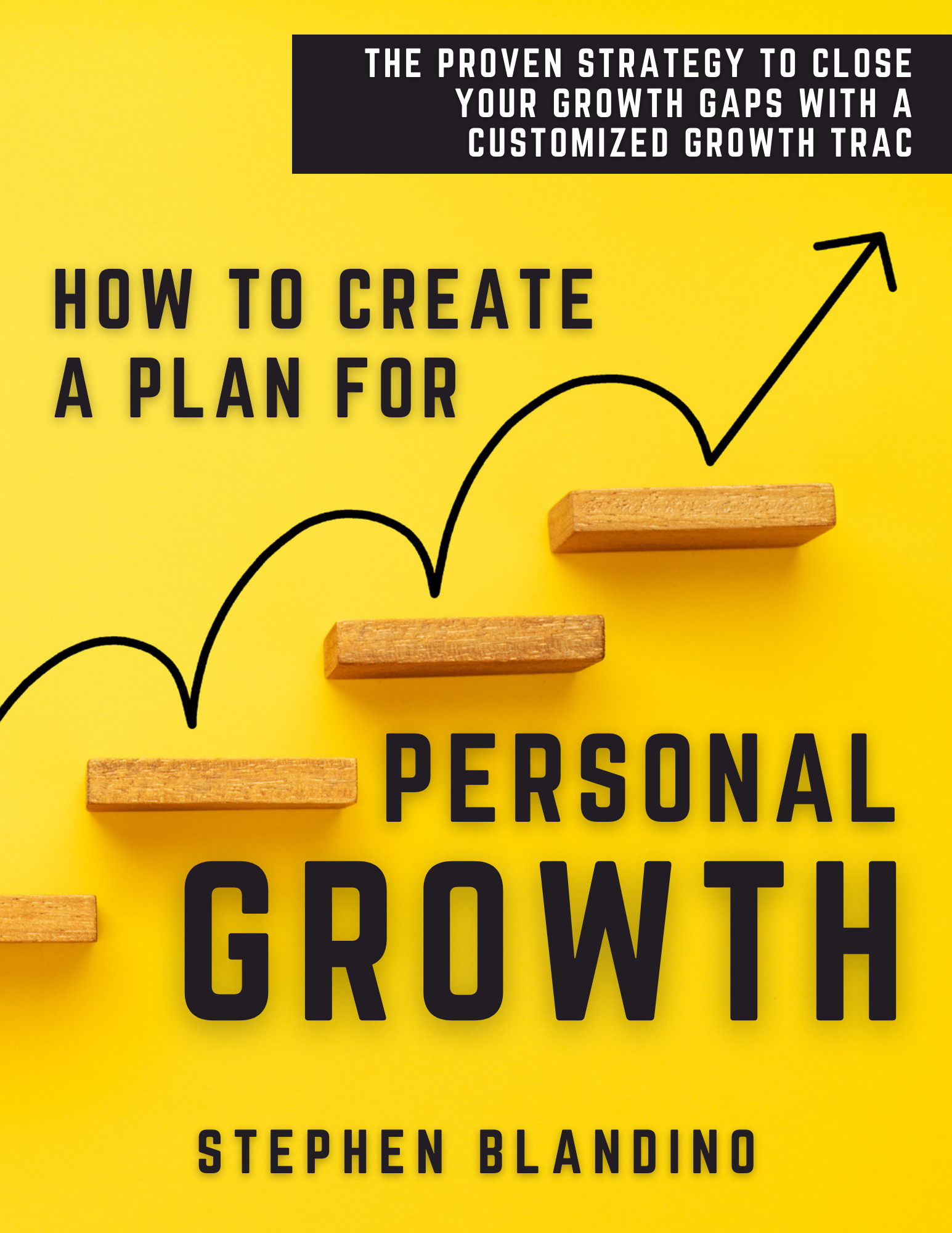
Practice #1: Growth TRACing – Creating, implementing, and monitoring your personal growth happens through the process of Growth TRACing (pronounced tracking). A Growth TRAC is like a personal growth plan that provides the framework and direction for your growth. It includes four ingredients: Target, Roadmap, Accountability, and Check-Ups.

Your Target is your personal growth goal—a carefully crafted statement that articulates in which area of life you want to grow. Your Roadmap includes the training, resources, coaching, and experiences you’ll leverage to reach your target (in other words, “how” you plan to grow). Accountability gives you the support to stay the course. And Check-Ups are the periodic evaluations where you measure progress and make midcourse corrections. Growth TRACing gives direction to your learning and ultimately produces growth traction.

Practice #2: Reflective Thinking – Reflective thinking is the habit of processing what you learn as you implement your Growth TRAC. It helps you mine for the gold in what you’re learning and typically requires three things: time, questions, and takeaways.

Setting aside think time is often perceived as a waste of time, yet it’s essential if you want to assimilate your learning into daily practice. This process begins by asking questions that help you make sense of what you’re learning. Your questions should then lead you to specific takeaways for application. While your Growth TRAC sets the course for your learning, reflective thinking helps you make that learning personal, applicable, and meaningful. Reflective thinking ultimately results in mental maturity.

Practice #3: Tenacious Application – The knowing/doing gap is the toughest to close but can actually happen when you put this “action equation” to work: Inner Resolve x Outer Support = Tenacious Application.

Inner resolve combines conviction and courage so you have the determination to act on what you’ve learned. Outer support is a combination of accountability and dependence. It taps ongoing accountability from others while being fully dependent on God for His strength. When you multiply inner resolve by outer support, the result is the tenacious application of the things you’re learning. Tenacious application helps you move from learning and thinking to actually doing. It ultimately results in personal transformation.

Continue Reading…

In my last two posts, I addressed What Jesus Said About Hearing God and How a Message from God can Change the Momentum of Your Life. One of the most common ways God speaks to us is through His Word. Perhaps that’s why the Apostle Paul said, “Let the word of Christ dwell in your richly…” (Colossians 3:16a).

The word “dwell” means to be at home in us. In other words, God’s Word should be like a welcome member of our family. Family members carry on conversations as they sit around the dinner table. In the same way, God’s Word should be allowed to speak freely into our lives.

Unfortunately, some people are afraid to let Scripture speak to them. They argue, “What if I misinterpret what it says?” If that’s your fear, then consider what Jesus said in John 16. After predicting his death, Jesus promises to send the Advocate—that is, the Holy Spirit. Then Jesus describes what the Holy Spirit will do.

“There is so much more I want to tell you, but you can’t bear it now. When the Spirit of truth comes, he will guide you into all truth. He will not speak on his own but will tell you what he has heard. He will tell you about the future. He will bring me glory by telling you whatever he receives from me. All that belongs to the Father is mine; this is why I said, ‘The Spirit will tell you whatever he receives from me.’ (John 16:12-16, NLT)

From this passage, I want you to notice three insights that are crucial to hearing God speak to you through His Word and His Spirit:

  • Being Truth Defines the Name and Nature of the Holy Spirit - Verse 13 begins, “When the Spirit of truth comes…” Jesus defines the Holy Spirit’s very name and nature. He’s not just any spirit…He’s the Spirit of Truth.
  • Speaking Truth Defines the Role and Responsibility of the Holy Spirit - Verse 13 continues, “…he will guide you into all truth. He will not speak on his own but will tell you what he has heard. He will tell you about the future.” Jesus tells us what the Spirit of Truth will do…he will guide us into truth. The Truth he speaks to us comes from Jesus himself. And who is Jesus? John said Jesus is the Way, the Truth, and the Life (John 14:6).
  • When the Spirit Speaks Truth to You, the Spirit Brings Glory to Jesus - I had never noticed this before. Verse 14 says, “He will bring me glory by telling you whatever he receives from me.” In other words, the act of the Holy Spirit speaking truth to you is also an act of worship to Jesus. You know what that tells us? The Holy Spirit wants to talk to you because when he does, he brings glory to the Son of God.

So if you’ve ever convinced yourself that God doesn’t want to speak to you, then remember the words of John 16. According to Jesus, every time the Holy Spirit speaks to you, he’s bringing glory to the Son. When you sit down to read the truth of Scripture, invite the Spirit of Truth to speak to you and to guide you.


In my last post I shared “What Jesus Said About Hearing God.” We learned that Relationship, not role, is the context for hearing and obeying the voice of God. The idea of hearing God draws mixed responses, but Scripture is clear that a relationship with God is a two-way street. God is more than a cosmic vending machine where we voice our prayers, press the “in Jesus name” button, and then out pops our answer. We are called to a relationship with him, not simply a role where we invoke his name at our every whim.

While the opportunity to hear God is cultivated in a relationship with him, there is also transformational power when God speaks. He may speak in a still small voice, but his words carry transformational authority. Consider this truth:

The right message from God, at the right moment in time, can change the momentum of your life. 

Like our first insight on hearing God, this one seems obvious too, so let me unpack it by exploring three messages from God. In other words, let’s look at three types of messages God often speaks:

1.  A Message of Encouragement

In Joshua chapter one, we read the story of Joshua. Moses had died and now Joshua was in charge of leading his people across the Jordan River into the land God had promised to give to them. After giving Joshua the exact parameters of the land, God changes his tone.

No one will be able to stand up against you all the days of your life. As I was with Moses, so I will be with you; I will never leave you nor forsake you. Be strong and courageous, because you will lead these people to inherit the land I swore to their forefathers to give them. Be strong and very courageous…Have I not commanded you? Be strong and courageous. Do not be terrified; do not be discouraged, for the Lord your God will be with you wherever you go.” (Joshua 1:5-7a, 9)

What did God do? He spoke a message—or a word—of encouragement to Joshua. But why? If I was about to give you a gift, would I really need to speak a word of encouragement to you before giving you the gift? God is about to give Joshua and Israel the land he had promised to them, but God has to encourage Joshua. It almost doesn’t make sense…until you reflect on Joshua’s age and his awareness of Israel’s history.

  • Joshua Knew His Age – Joshua was not a young man full of energy when the time came to cross the Jordan. How do we know this? Because Joshua’s sidekick, Caleb, was 40 years old when Moses sent him and Joshua to spy out the Promised Land (Joshua 14:7). Some theologians believe Joshua and Caleb were similar in age. Now, add to that another 40 years when Israel wandered in the wilderness for failing to believe God for the Promised Land. That puts Joshua at the ripe age of 80 when he stood at the shore of the Jordan. Have you ever dreamed of doing something great but the very first uncertainty to cloud your mind was, “What if I’m too old?” Joshua needed encouragement because he didn’t have the energy of his youth any longer.
  • Joshua Knew His History – In Numbers 13 we read that Moses sent a group of 12 men (one leader from each ancestral tribe) to explore the land of Canaan which God had promised to give to the Israelites. After 40 days of exploring the land, the men returned to Moses and Aaron with their report. Caleb, one of the spies, boldly declared his report.

“We should go up and take possession of the land, for we can certainly do it.” But the men who had gone up with him said, “We can’t attack those people; they are stronger than we are.” And they spread among the Israelites a bad report about the land they had explored.” (Numbers 13:30-32a)

As a result of their disbelief and their disobedience, they were defeated by the Amalekites and the Canaanites. Even though this happened 40 years earlier, the image of rebellion and the image of defeat were probably fresh in Joshua’s mind. As the Lord instructs him to cross the Jordan into the Promised Land, I can imagine that all of the emotions from 40 years earlier quickly resurfaced. “What if the people rebel again? What if God doesn’t go with us? What if we’re defeated?”

When you look at your personal history, and when you see the challenges of your past, do you need encouragement to take the next step of faith in your journey? Joshua certainly did. And that’s where this simple truth about hearing God is so powerful:

The right message from God, at the right moment in time, can change the momentum of your life. 

That’s exactly what happened to Joshua. Now, you might say, “But God’s message to Joshua was, ‘Be strong and courageous.’ It doesn’t sound like encouragement as much as it sounds like a command.”

So what does the word “encourage” mean? “Encourage” actually means to “Put Courage In.” So when God speaks to Joshua, he is using his words to “put courage in” Joshua’s heart. And that word—or that message—of encouragement was the catalyst Joshua needed to act on what God promised to him. It literally changed the momentum of his life, and of the Israelites.  Continue Reading…

Our world is filled with a lot of noise. In fact, it’s becoming increasingly more difficult to detach ourselves from noise and distractions and find a quiet place where we can rest, reflect, and draw closer to God. You might even be asking, “Is there any such place as a quiet place any more?”

Well, yes…but you have to go to Minneapolis to find it. There you will discover a room that’s 99.99% sound proof. Interestingly, Steven Orfield, whose company is responsible for creating this sound proof room, said, “The quieter the room, the more things you will hear.” In fact, it’s so quiet that the longest any person has been able to stay in the room is 45-minutes. What does that say about our culture?

God understands the need for quiet. Psalm 46:10 says, “Be still, and know that I am God! I will be honored by every nation. I will be honored throughout the world.” It’s in the “stillness” that our hearts and minds are calibrated to the presence of God. It’s in the stillness that we hear God. That might sounds strange to you…maybe even bizarre. But God is active in our world today, and I believe He desires to speak to you and me. He doesn’t have a permanent case of laryngitis, unable to speak any longer. He loves you…and like any “love” relationship, He wants to speak, not just listen. But how do we listen? Where do we begin? And how do you “hear God” without others calling you a lunatic.

As you reflect on Scripture, you will discover a truth that is at the core of hearing the voice of God. In fact, it’s a truth so simple that we often miss it:

Relationship, Not Role, is the Context for Hearing and Obeying the Voice of God

So what does Jesus have to say about the topic of hearing God? In John 10, Jesus says that he is the “gate for the sheep.” In other words, he’s declaring that he is the way—the entry point—to a relationship with Father God. But then Jesus begins contrasting a good shepherd and a hired hand. I want you to notice the difference Jesus points out between the two:

  • The shepherd makes sacrifices while the hired hand looks for security – John 10:11-12a says, “I am the good shepherd. The good shepherd sacrifices his life for the sheep. A hired hand will run when he sees a wolf coming.”
  • The shepherd knows his sheep while the hired hand knows of the sheep – Verse 12 says, “A hired hand will run when he sees a wolf coming. He will abandon the sheep because they don’t belong to him and he isn’t their shepherd. And so the wolf attacks them and scatters the flock.”
  • The shepherd cares about the sheep while the hired hand cares about his salary – Verses 13-14 say, “The hired hand runs away because he’s working only for the money and doesn’t really care about the sheep. I am the good shepherd; I know my own sheep, and they know me.”

So what do these differences between the shepherd and the hired hand have to do with hearing God? One word: RELATIONSHIP. The hired hand had a role, but the shepherd had a relationship. The sheep recognize the voice of the one with whom they have a relationship.

Continue Reading…

How you think has the power to unlock your future. In fact, reaching your full potential begins first in your mind. You must Think to Your Full Potential before you see your potential fully realized. While there are numerous approaches to embrace in our thinking, I believe positive and resilient thinking are crucial. Consider two passages of Scripture:

Peter 3:1 – Dear friends, this is now my second letter to you. I have written both of them as reminders to stimulate you to wholesome thinking.  

Philippians 4:8 – Finally, brothers, whatever is true, whatever is noble, whatever is right, whatever is pure, whatever is lovely, whatever is admirable—if anything is excellent or praiseworthy—think about such things.

These two passages demonstrate the power of positive and resilient thinking. Being positive and resilient go hand in hand. Why? Because the need for positive thinking is most evident when we face setbacks in our lives. When we are positive, we’re able to be resilient…to bounce back from the setback.

In his book, The 15 Invaluable Laws of Growth, John Maxwell illustrates the power of positive and resilient thinking in “The Law of Pain.” The Law of Pain says, “Good management of bad experiences leads to great growth.” Maxwell shares the story of Cheryl McGuinness to illustrate this law.

Cheryl lived through the horrific terrorist acts of 9/11…but her husband Tom did not. Tom was a pilot for American Airlines, and on September 11, 2001, Tom was the co-pilot of Flight #11, the first plane to crash into the World Trade Center.

Very quickly Cheryl discovered what it was like to be a single mom and a widow, but she coped the best that she could. As you reflect on her response, you quickly see that she chose a path of positive and resilient thinking. In her book, Beauty Beyond the Ashes, Cheryl says:

“I am learning more each day. The circumstances of 9/11 have forced me to examine who I am, to face myself in ways that I never had to before, to ask, ‘What does God want for me? What can I do in him, by his power within me? How will he use me to touch others?’ I am learning more about myself and about God. And I am learning it on my own, not through Tom’s filter.”

Because she chose a positive and resilient attitude, Cheryl has grown into a person she otherwise would not have become, despite the terrible acts of 9/11. On the 10th anniversary of 9/11 she said, “It’s a terrible, terrible day that I don’t think anybody can ever forget…Out of the ashes of September 11, out of the rubble that day, I can emerge to say that I am stronger today than 10 years ago.”

Cheryl’s good management of a bad experience has truly led to her growth. Positive and resilient thinking keeps our potential from dying with our pain. And if you’re going to reach your full potential, you must think positively and choose resilience even when your circumstances dictate otherwise.

Question: How has positive and resilient thinking changed your life and shaped your circumstances?


Most people would eagerly admit that they want to reach their full potential. That process often starts at the beginning of a new year when we wipe the slate clean and start with a fresh set of goals. But if we’re not careful, we’ll carry our old way of thinking into our new ambitions for the future. Not until we change how we think can we unlock the door to our future.

I would suggest that your biggest problem is not your biggest problem. Lack of money, education, opportunity, influence, time, or ability are not your biggest problems. How you think, and how I think, is our biggest problem. How we think defines who we are. Poverty of the mind always precedes poverty of our circumstances.

One of the biggest things that sabotages our thinking is what I call “i3 Thinking.” i3 Thinking is inferiority, inadequacy, and insecurity. These three ugly monsters so easily imprison our lives.

  • Inferiority – Inferiority sells us a lie that everybody is better than us. We say to ourselves, “If I had more money, more connections, or more talent, then I would (fill in the blank).” Then we point at someone we consider superior to ourselves and say, “Pick her!” We benchmark ourselves against the people who we think are “the most qualified.” We look at people like Mother Teresa and say, “If I was like her, then I could make a difference too.” But how quickly we forget Mother Teresa’s words: “If you can’t feed a hundred people, then feed just one.” Inferiority focuses on everybody else’s superiority rather than on our personal responsibility.
  • Inadequacy – Inadequacy is the first cousin to inferiority. While inferiority makes the measure of success too high, inadequacy makes the assessment of one’s self too low. Inferiority says, “They’re too good for me.” Inadequacy says, “I’m too bad for them.” While inferiority focuses on everybody else’s superiority, inadequacy focuses on my insufficiency.
  • Insecurity – The third thinking barrier is driven by an attitude of fear. Insecurity focuses on the what-ifs and the what-might’s. We use excuses like “What if I fail?” or “What if I look foolish?” or “What if I let someone down?”

Even the Apostle Paul faced feelings of inferiority, inadequacy, and insecurity? Here’s a guy who wrote much of the New Testament, but when those feelings knocked on the door of his life, he simply chose not to open the door. For example, in 2 Corinthians we read about “false prophets” who were going around teaching and deceiving believers in the early church. What did Paul say?

For if someone comes to you and preaches a Jesus other than the Jesus we preached, or if you receive a different spirit from the one you received, or a different gospel from the one you accepted, you put up with it easily enough. But I do not think I am in the least inferior to those “super-apostles.” I may not be a trained speaker, but I do have knowledge. We have made this perfectly clear to you in every way. (2 Corinthians 11:4-6)

Inferiority tried to take hold of Paul’s thinking, but he refused to give it authority in his life. Consider also the modern-day story of Johnnetta McSwain. Johnetta struggled with inferiority, inadequacy, and insecurity more than most people. She was born to a single mom who didn’t want her, abused by her uncles, dropped out of school when she was in the 11th grade, and lived on the streets. She had two sons born out of wedlock and she would shoplift so she could dress in designer clothes.

But something changed on Johnnetta’s 30th birthday. She said, “That day I woke up and realized I had absolutely nothing to celebrate–no money, no full-time job, no home, no husband, and no clue, not even the will to do better…At last, I knew it was time to make some changes.”

And change she did. After two attempts she passed the test to get her GED. Driven by the thought that she had a chance to be anyone that she wanted to be, Johnnetta moved to Atlanta and enrolled in Kennesaw State University. She said, “I realized I didn’t have to be smart, I just had to be determined, motivated, and focused. This came with a high price tage for me. I had to exchange my thinking. I had to think like a smart person.” 

Johnnetta’s situation eventually changed. She graduated, then completed her Master’s, and now she’s working on her doctorate. But I want you to notice something critical to Johnnetta’s success. Before she could change her circumstances, she had to change her thinking. Inferiority, inadequacy, and insecurity had to be given an eviction notice. Step-by-step she had to choose to think differently.

If you are ever going to reach your full potential, it starts with your thinking. You have to throw away i3 Thinking (inferiority, inadequacy, and insecurity). Even though it feels like a giant magnet constantly pulling you to return to your old way of thinking, you have to make deliberate and disciplined choices everyday to step in a new direction. Zig Ziglar captured it best when he said:

“It’s impossible to consistently behave in a manner inconsistent with how we see ourselves. We can do very few things in a positive way if we feel negative about ourselves.”

Question: How are you overcoming inferiority, inadequacy, and insecurity in your life?


As one year comes to a close and a new year begins, I like to share my top posts from the previous year. So, below you’ll find my top ten posts from 2012. Enjoy!

1. Productive Paranoia: Lesson #3 from Jim Collins’ Great by Choice

2. Empirical Creativity: Lesson #2 from Jim Collins’ Great by Choice

3. Amazon’s Culture: How to Shape an Enduring Organizational Culture

4. 10 Words of Wisdom to Young Leaders

5. What Does It Mean to Trust God?

6. What to Do When You Lose Your Passion

7. 7 City Church: What’s in a Name?

8. George Washington on Servant Leadership

9. 7 Types of Questions to Ask During an Interview

10. The Holy Spirit’s Role in Leadership

Question: Which article was most helpful to you and why? What was your favorite article that didn’t make the top ten?