Archives For Leadership

I can still remember reading John Maxwell’s early leadership book, Developing the Leader Within You, and thinking, “This is the best leadership book I’ve ever read.” Suddenly it occurred to me: “This is the only leadership book I’ve ever read.”

For years, personal growth wasn’t anywhere on my radar. I hated reading and throughout most of college, I only cracked half my textbooks (nothing like spending dad’s money to buy books you never read). Turns out, I wasn’t alone. Only 45% of Americans over the age of 13 read a book in the course of a year.

After graduating college with all the answers, it took me a couple of years to realize how little I actually knew. Eric Hoffer’s words described me well:

“In times of profound change, the learners inherit the earth, while the learned find themselves beautifully equipped to deal with a world that no longer exists.”

I was well-prepared for irrelevance. That newfound humility forced me into a learning mode. In the years that followed—mostly out of necessity—I developed a habit of reading. But more importantly, I stumbled upon five practices of personal growth that transformed my life. The first three practices maximize growth within us and the last two practices leverage growth in the people we influence.

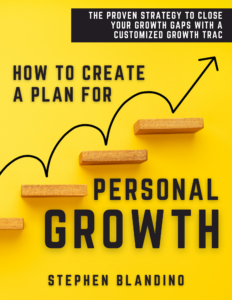
Practice #1: Growth TRACing – Creating, implementing, and monitoring your personal growth happens through the process of Growth TRACing (pronounced tracking). A Growth TRAC is like a personal growth plan that provides the framework and direction for your growth. It includes four ingredients: Target, Roadmap, Accountability, and Check-Ups.

Your Target is your personal growth goal—a carefully crafted statement that articulates in which area of life you want to grow. Your Roadmap includes the training, resources, coaching, and experiences you’ll leverage to reach your target (in other words, “how” you plan to grow). Accountability gives you the support to stay the course. And Check-Ups are the periodic evaluations where you measure progress and make midcourse corrections. Growth TRACing gives direction to your learning and ultimately produces growth traction.

Practice #2: Reflective Thinking – Reflective thinking is the habit of processing what you learn as you implement your Growth TRAC. It helps you mine for the gold in what you’re learning and typically requires three things: time, questions, and takeaways.

Setting aside think time is often perceived as a waste of time, yet it’s essential if you want to assimilate your learning into daily practice. This process begins by asking questions that help you make sense of what you’re learning. Your questions should then lead you to specific takeaways for application. While your Growth TRAC sets the course for your learning, reflective thinking helps you make that learning personal, applicable, and meaningful. Reflective thinking ultimately results in mental maturity.

Practice #3: Tenacious Application – The knowing/doing gap is the toughest to close but can actually happen when you put this “action equation” to work: Inner Resolve x Outer Support = Tenacious Application.

Inner resolve combines conviction and courage so you have the determination to act on what you’ve learned. Outer support is a combination of accountability and dependence. It taps ongoing accountability from others while being fully dependent on God for His strength. When you multiply inner resolve by outer support, the result is the tenacious application of the things you’re learning. Tenacious application helps you move from learning and thinking to actually doing. It ultimately results in personal transformation.

Continue Reading…

As one year comes to a close and a new year begins, I like to share my top posts from the previous year. So, below you’ll find my top ten posts from 2012. Enjoy!

1. Productive Paranoia: Lesson #3 from Jim Collins’ Great by Choice

2. Empirical Creativity: Lesson #2 from Jim Collins’ Great by Choice

3. Amazon’s Culture: How to Shape an Enduring Organizational Culture

4. 10 Words of Wisdom to Young Leaders

5. What Does It Mean to Trust God?

6. What to Do When You Lose Your Passion

7. 7 City Church: What’s in a Name?

8. George Washington on Servant Leadership

9. 7 Types of Questions to Ask During an Interview

10. The Holy Spirit’s Role in Leadership

Question: Which article was most helpful to you and why? What was your favorite article that didn’t make the top ten? 


GO!If you haven’t picked up a copy of my book, GO! Starting a Personal Growth Revolution, now is your chance to do so at an unbeatable price. Monday – Wednesday, December 17-19, 2012, you can download the Kindle version of GO! at no cost. It’s the perfect early Christmas gift that will help you grow to your full potential as you enter a new year. So spread the word and tell your friends on Twitter and Facebook.

GO! is endorsed by some great people like leadership consultant Dr. Sam Chand, Pastor Herbert Cooper, Professor Dr. Doris Gomez, LifeChurch.tv Team Development Leader Jerry Hurley, and Syndicated Radio Host Bill Barnett.

No matter where you are in your personal growth journey, GO! will help you define and take your next step. GO! is for anyone who wants to:

  • Close the gap between who they are and who they want to become
  • Create a customized personal growth TRAC
  • Get “unstuck” in their journey toward their dreams
  • Inspire and unleash growth in others
  • Maximize their potential by climbing the five levels of personal growth

Click HERE to learn more about GO! Or, to get your FREE copy on Kindle for a limited time, click HERE. And if you don’t mind, do me a favor and spread the word with your friends and followers on Facebook and Twitter. If you would prefer a paperback version, you can purchase a copy HERE.


In my last few posts I’ve shared insights from the New Testament book of James on problems, temptation, taking action, words, and how to become wise. I want to conclude this series from James by looking at how to handle conflicts.

Everybody handles conflicts from a variety of perspectives. Some people try win conflicts at all costs. Others pretend they don’t exist or simply whine about them, hoping they will magically disappear. Still, others leverage their leadership position or power to get their way. Some even quit without trying. The responses are diverse, but James offers an entirely different perspective on conflict.

James begins this section of his letter by introducing three types of conflict:

1.  External Conflict

He begins with a question: “What causes fights and quarrels among you?…” (James 4:1). When James speaks of fights and quarrels, he’s referring to relational conflict among other followers of Christ. This is one of the themes we see throughout James’ letter where he references conflict between the rich and poor, personal conflict, judging others, and employer/employee conflicts.

While everybody experiences external conflict, some people perpetuate conflict. Take Billy Martin for example. On June 23, 1988, Billy Martin was fired for the fifth time as manager of the New York Yankees. His entire career was laced with fist fights, disagreements, and constant conflict. He jumped from one team to another before becoming a coach. But even as a coach, Martin’s pattern of conflict continued.

Whether fighting with Reggie Jackson, hitting a 64-year old traveling secretary with the Texas Rangers, or clobbering a marshmallow salesman, Billy Martin made conflict his closest ally. Jim Murray, a Pulitzer Prize winning sports columnist, once said, “Some people have a chip on their shoulder. Billy has a whole lumberyard.” And when asked why he was fired so often, Martin said, “I get fired because I’m not a yes-man. The world’s full of yes-men.”

The only point Martin proves is this: the biggest issue in any conflict is a person’s own health. Conflict shouldn’t be viewed through the lens of agreement or disagreement or right or wrong. It should be viewed through the lens of your own health. Healthy people successfully navigate conflict. Unhealthy people produce and perpetuate conflict—like Billy Martin did. As the old saying goes, “Hurting people hurt people.” And that brings us to the second observation made by James.

2.  Internal Conflict

James does more than simply identify conflicts in the church. He goes to the root of the problem observing that external conflict is the result of internal conflict. James 4:1 says:

What causes fights and quarrels among you? Don’t they come from your desires that battle within you?

The desires James refers to are sensual desires. And where do these desires come from: selfish wants. Then James shows a progression—an escalation—in conflict because these selfish wants go unsatisfied. He says:

…You want something but don’t get it. You kill and covet, but you cannot have what you want. You quarrel and fight… (James 4:2a)

Notice the connection between wants and wars. James says “…You want something but don’t get it.” That’s the internal want. But then he says, “You kill and covet, but you cannot have what you want. You quarrel and fight…” That’s the external war. The point is clear:

Our unfulfilled internal wants produce our uncontrolled external wars.

Take a moment and think about a relationship where you’re having the most conflict. Maybe it’s a relationship with your spouse. Maybe it’s a relationship with your boyfriend or girlfriend. Perhaps it’s a relationship with a co-worker, boss, or another follower of Christ. Maybe it’s with one of your kids.

At the core of the external conflict, an internal want is not being satisfied. So my question to you is this: Who do you want to satisfy your want? If your expectation is for somebody else to satisfy your want, then you will always be at war with that person. Why? Because people cannot make you happy. As long as you rely on others to make you happy, you will always experience internal conflict that results in external conflict. Does that mean people should be allowed to treat you anyway they want to? Of course not. But here’s the truth I want you to understand:

If you always expect their will to match your wants, you’ll always be at war.

Everybody has a will (the ability to choose). But when we expect people to choose to satisfy our wants and desires, war often erupts. So where do these unfulfilled internal wants come from? In other words, where do they originate? According to James, they come from upward conflict. Continue Reading…

How to Become Wise

November 1, 2012 — Leave a comment

The book of James is often considered the proverbs of the New Testament because of the wisdom it contains. In my last few posts I’ve shared several insights from James on problems, temptation, taking action, and words. Today, I want to look at How to Become Wise. 

Bill Cosby once said, “A word to the wise ain’t necessary; it’s the stupid ones who need the advice.” While there’s some humor in that quote, even the wise understand the importance of lifelong learning, coaching, and personal application.

James begins with a question his observations on wisdom with a question: “Who is wise and understanding among you?” (James 3:13) In the Old Testament, wisdom was considered to be the most valuable possession a person could have. In fact, in 1 Kings 3, we read the story of King Solomon having a dream one night where God said to him, “Ask for whatever you want me to give you.” Rather than asking for wealth, power, or possessions, Solomon said:

“So give your servant a discerning heart to govern your people and to distinguish between right and wrong. For who is able to govern this great people of yours. (1 Kings 3:9)

And God responded to Solomon’s request:

“…I will give you a wise and discerning heart, so that there will never have been anyone like you, nor will there ever be. Moreover, I will give you what you have not asked for—both riches and honor—so that in your lifetime you will have no equal among kings. And if you walk in my ways and obey my statutes and commands as David your father did, I will give you a long life.” (1 Kings 3:12-14)

Wisdom was a big deal to the Hebrews. It was far more than knowledge. It was much more than information or instruction. At it’s core, wisdom was behavioral. The Jews believed wisdom to be the skill of living righteously. The focus wasn’t knowledge of the truth but rather application of the truth.

In his book, The Divine Mentor, Wayne Cordeiro observes that wisdom is a higher form of knowledge. He compares it to sodium. Sodium in its raw form can be destructive. But when it’s converted into sodium chloride, or table salt, it is beneficial. Knowledge is the same way. It was never meant to be an end in itself. Knowledge must be converted into a higher form–wisdom–before it becomes truly beneficial to us.

Jesus understood that wisdom was greater than knowledge when he said:

“Therefore everyone who hears these words of mine and puts them into practice is like a wise man who built his house on the rock.” (Matthew 7:24)

Who did Jesus say is wise? Not the person who hears the truth, but the person who puts it into practice. When James said, “Who is wise and understanding among you?” he was asking, “Who among you is skilled in living righteously?”

From his opening question, James begins a comparison between two types of wisdom. He compares True Wisdom and False Wisdom. He contrasts Godly wisdom and ungodly wisdom. And from this comparison we discover three ways to become wise.

1.  Choose the Source of Your Wisdom

As James begins his comparison, he starts with the source of these two kinds of wisdom. The Source of True Wisdom is “Heaven.” Verse 17 says, “But the wisdom that comes from heaven…” This is a direct reference to a Person (God) more than a place (heaven). So what else does the Bible say about the source of true wisdom?

  • Christ is the Source of True Wisdom - Colossians 2:3 says, “…that they may know the mystery of God, namely, Christ, in whom are hidden all the treasures of wisdom and knowledge.” And 1 Corinthians 1:30 says, “It is because of him that you are in Christ Jesus, who has become for us wisdom from God—that is, our righteousness, holiness and redemption.”
  • The Bible is the Source of True Wisdom - 2 Timothy 3:14-15 says, “But as for you, continue in what you have learned and have become convinced of, because you know those from whom you learned it, and how from infancy you have known the holy Scriptures, which are able to make you wise for salvation through faith in Christ Jesus.”
  • Prayer Gives Us Access to True Wisdom - Finally, James 1:5 says, “If any of you lacks wisdom, he should ask God, who gives generously to all without finding fault, and it will be given to him.”

In the same way True Wisdom has a source, so does false wisdom. James 3:14-15 says, “But if you harbor bitter envy and selfish ambition in your hearts, do not boast about it or deny the truth. Such “wisdom” does not come down from heaven but is earthly, unspiritual, of the devil.” Notice what James says about the source of false wisdom. He says its:

  • Earthly – In other words, false wisdom is confined to the present world and is restricted to the ideas and theories of people.
  • Unspiritual – It’s wisdom that’s corrupted by man’s fallen sinful nature.
  • Of the Devil – It’s ultimately rooted in Satan himself.

When you compare the source of false wisdom with the source of true wisdom, the choice seems obvious. But when it comes to the actual application of wisdom, the choice isn’t so easy. Why? Because false wisdom is our natural default response to life, whereas true wisdom requires faith. It requires faith in God. It requires faith in His Word. And it requires faith when God’s wisdom doesn’t even seem to make sense. That “faith” tension is why so many times we end up falling on the “false wisdom” side of things.

2.  Practice the Application of Wisdom

You can apply false wisdom or you can apply true wisdom. The choice is up to you. Look at what happens when you apply false wisdom. According to James 3:14, false wisdom has four characteristics: bitter envy, selfish ambition, pride, and lies. James said, “But if you harbor bitter envy and selfish ambition in your hearts, do not boast about it or deny the truth.”

Continue Reading…

Good coaching is significantly shaped by your ability to ask good questions. Because coaching is more about “drawing out” than “pouring in”, it is essential that you leverage question-asking to mine for the gold inside of your team members. Jesus was a master at coaching with questions.

Obviously the questions you ask vary based on the situation, as well as the responses, you are given. However, questions are not the only ingredient in a coach’s arsenal. “Coaching Phrases” are equally important. Here are three that I find particularly helpful:

1. “Unpack That For Me” - This is one of my favorite phrases. When I’m talking with a team member, I’ll often use this phrase after they’ve shared an idea, observation, or struggle. This is a great phrase to use when the suitcase has been unlocked and you need to open it to see what’s inside. It’s a permission-giving statement that allows you to hear what the person you’re coaching is really feeling or thinking. “Unpack that for me” often provides the backstory behind the situation at hand.

2. “Help Me Understand” - This is a good statement to use when you’re trying to understand the logic behind a team member’s ideas, thoughts, or actions. I’ve found it helpful in two situations: gaining clarity and giving correction. First, “Help me understand” brings clarity to “What” situations. It helps you better understand what a person means or what they intend to do. Second, “Help me understand” introduces the need for correction in “Why” situations. Rather than saying, “Why on earth did you ____________.” A better approach is to say, “Help me understand your thoughts behind why you did ___________.” It gives the person being coached the opportunity to share their reasoning before you provide any necessary correction.

3. “Tell Me Your Options” - This is a good phrase to use after listening to a situation in need of a solution. Rather than being the answer man, use the “Tell me your options” phrase to get people to think for themselves. That’s what good coaches do. Plus, it helps the person being coached own their problems and, just as importantly, own their solutions. You might even follow up the “Tell me your options” phrase with a “What else?” question. This helps them drill down on their options and not settle for the easiest answer.

Question: What other “coaching phrases” have you found helpful?


How to Handle Problems

October 14, 2012 — 2 Comments

The book of James was one of the earliest written books of the New Testament. James was a respected leader of the church in Jerusalem who dealt with some of the most practical issues of everyday life. Some have referred to James as the Proverbs of the New Testament. While the issues in James are common challenges, the advice James offers is uncommon wisdom.

Now, everybody faces problems. In James’ day, the problem the church was facing was persecution for their faith in Christ. So, straight out of the gate, James tackles this problem head on. Does he tell these early believers that God will comfort them in their problems? No! Does he offer encouraging words to those facing the fear of death? Nope! Does he speak words of affirmation, hope, or peace? Not one word! James offers three words of advice to those facing problems:

1. GAIN PERSPECTIVE

Whether big or small, every one of us have problems that fight to take center stage in our lives. The truth about problems is that we often add a problem to our problems. As if the cake wasn’t big enough already, we finish it off with a layer of problematic icing called “problematic perspective.” Perspective makes all the difference in how we view and respond to problems. In fact, without the right perspective, we live with a terminal case of nearsighted with our problems.

Consider the college girl who wrote a letter to her mom during her first semester of school. In an attempt to help her mom gain perspective, she wrote:

Dear Mom,

Since I have been away at college, one full semester, I think it’s time I bring you up to date as to what is going on. Shortly after I arrived at college, I got bored with dormitory life and stole fifty dollars from my roommate’s purse. With the money, I rented a motorcycle, which I crashed into a telephone pole a few blocks from the dorm.

I broke my leg in the accident, but I was rescued by the young doctor who lives upstairs in the apartment house on the corner. He took me in, set my leg, nursed me back to health, and thanks to him, I’m up and around again.

We wanted to let you know that we’re going to be married as soon as possible. Unfortunately, we’re having some trouble with the blood test—they’re not sure what the disease is, but it keeps showing up in the test. We hope to get that worked out quickly so that we’ll be married before the baby arrives. Shortly thereafter we will be home to live with you and Dad. And I just know you will learn to love the baby as much as you love me, even though the baby’s dad is a different religion and wants us to convert. Please understand, the only reason we’re coming back home to stay is that my husband-to-be got tossed out of medical school because he was too busy taking care of me to complete his work.

Really, Mom, I didn’t steal any money or rent a motorcycle or hit a telephone pole or break my leg. I didn’t meet a young doctor. There’s no disease and I’m not expecting a baby. And I won’t be coming home to live with you and Dad either. However, I am getting a D in algebra and an F in geology, and I wanted you to accept these grades in their proper perspective!

Perspective changes everything. The attitude with which we view our problems often determines the outcome. James understood this truth when he wrote:

Consider it a sheer gift, friends, when tests and challenges come at you from all sides. You know that under pressure, your faith-life is forced into the open and shows its true colors. So don’t try to get out of anything prematurely. Let it do its work so you become mature and well-developed, not deficient in any way. (James 1:2-4 – The Message)

I don’t know about you, but James’ advice on how to view problems is not my natural response to the problems I face. I don’t see my problems as a sheer gift. But James understood this reality about problems: problems work for us, not against us. In fact, James helps us see that the problems we face in life do two things:

  • They REVEAL our Character – “…You know that under pressure, your faith-life is forced into the open and shows its true colors.”
  • They REFINE our Character – “…So don’t try to get out of anything prematurely. Let it do its work so you become mature and well-developed, not deficient in any way.”

Interestingly, James revisits the importance of perspective a few verses later:  Continue Reading…

Multiplying Your Growth

September 15, 2012 — Leave a comment

The concept of multiplication isn’t new, especially in the world of leadership. While it may not happen as often as it should, most leaders understand that unless they move beyond the addition of workers to the multiplication of leaders, they will never maximize their potential, or the potential of the organization, ministry, or department they lead.

The same principle holds true with personal growth. You can grow yourself and even impact others, but multiplication is an entirely different level. In the same way a rock tossed in a pond creates a series of ripples, the Multiplying Level of personal growth initiates an enduring process of personal growth ripples. Those ripples form when you help somebody grow, and then they turn around and invest in the growth of others. At this level, personal growth revolutions spread and even have the potential to go viral.

My grandmother—Violet Morley—recently passed away at the age of 92. She wasn’t popular or famous or rich. You won’t find her name in the history books of earth. But you can be sure that her name is remembered in the halls of eternity. She was a deeply spiritual woman with an unwavering commitment to prayer.

I’m convinced that Grandma’s name was known in heaven and in hell—heaven because she spoke to Jesus daily, and hell because she fought the enemy fearlessly. She once told me, “We have to do many different things, but prayer is the main thing.”

On the day that she died, my mom told me that grandma’s life was like a ripple—an enduring set of prayer ripples. Those ripples were felt in countless lives as one friend and family member after another surrendered their lives to Christ. At her funeral, letters were read and messages were shared by people who grandma “prayed into the Kingdom.” On three separate occasions, those in attendance stood to their feet in applause of this tiny, insignificant lady who had a Mount Everest sized prayer life.

When I reflect on her prayer journey, I realize that she didn’t take the journey alone. She mentored others in prayer, and she passed her prayer habit on to future generations. Prayer was more than a personal habit. It was a multiplied habit. She might have been a little lady, but she grew and multiplied a contagious prayer life…in her, around her, and beyond her.

A great biblical example of the highest level of growth is found in the book of 1 Thessalonians. Paul, Silas, and Timothy express gratefulness in their letter to the church in the city of Thessalonica. After an initial greeting, they write:

For we know, brothers loved by God, that He has chosen you, because our gospel came to you not simply with words, but also with power, with the Holy Spirit and with deep conviction. You know how we lived among you for your sake. You became imitators of us and of the Lord; in spite of severe suffering, you welcomed the message with the joy given by the Holy Spirit. And so you became a model to all the believers in Macedonia and Achaia. The Lord’s message rang out from you not only in Macedonia and Achaia—your faith in God has become known everywhere. (1 Thessalonians 1:4-8)

I want you to see the personal growth ripples in this passage. It started with Paul, Silas, and Timothy when they said, “You know how we lived among you for your sake.” They began by living their growth. What they learned and thought transformed how they lived. Out of the overflow of personal transformation, they intentionally impacted the Thessalonians—“You became imitators of us and of the Lord…”

But the growth didn’t stop there. Multiplication kicked in: “And so you became a model to all the believers in Macedonia and Achaia. The Lord’s message rang out from you not only in Macedonia and Achaia—your faith in God has become known everywhere.”

What the Thessalonians received from Paul, Silas, and Timothy’s growth was more than an inspiring model that impacted how they lived. They were empowered to multiply that transforming work in the people around them. These men didn’t keep their growth a secret. Nor did the Thessalonians let the growth ripple end with them. They chose to invest in the believers in Macedonia and Achaia who then, invested in people “everywhere.” That’s exponential growth. That’s the power of multiplication. Paul, Silas, and Timothy’s personal growth started a growth revolution in people they never even met.

Question: What would have to happen for you to begin multiplying your growth through others?

This post was adapted from my book, GO! Starting a Personal Growth Revolution. You can order a copy in my store here or on Amazon or KindleGO! is also available from Barnes & Noble. For bulk orders, email me here.

7 Days of Growth

September 4, 2012 — Leave a comment

GO!I’m excited to announce the release of my new book, GO! Starting a Personal Growth Revolution. You can learn more HERE or purchase a copy in my store HERE or on AMAZON HERE. For bulk orders and pricing, email me HERE.

To celebrate the release of the book, I’d like to invite you to participate in 7 DAYS OF GROWTH. Beginning Sunday, September 9th I’ll release a new post on my blog for 7 days featuring content from my book. Each day will challenge you with a practical component to growth and help you leverage personal growth within you and around you. Plus, you can share your thoughts and ideas on each post and benefit from the observations of others too.

How Do I Sign Up?

To receive “7 Days of Growth” simply sign up for my blog (See the pop up bar at the bottom of this page). Then each post will be delivered directly to your email inbox. Plus, when you sign-up for my blog, you’ll be able to download the first two chapters of my book.

GO! is for anyone who wants to unlock their personal growth or inspire growth in others. If you feel stuck, don’t know how to close the gap between where you are and where you want to be, want to maximize your own growth, or want to learn how to help others growth, then GO! provides you the roadmap to get there. GO! will equip you to:

  • Close the gap between your reality and your dreams
  • Access the three on-ramps to personal growth
  • Create a customized personal growth TRAC
  • Leverage the five levels of personal growth to start a growth revolution in you, around you, and beyond you
  • Transform your thinking, move beyond good intentions, and experience personal transformation 
  • Maximize your personality type to grow to your full potential
  • Make intentional investments in others by using six growth deposits
  • Multiply your personal growth for continual impact

GO! is packed with inspirational stories, practical insight, and applicable ideas. Whether you’re a pastor, coach, leader, HR professional, student, or you simply want to take your personal growth to a new level, GO! will help you take your next step.

What Others Are Saying About GO!

“Some books are written to inform, and others to inspire, still others to motivate you to action. In GO! Starting a Personal Growth Revolution author Stephen Blandino does all three. You will learn, grow and move forward. The concepts are real-life and the strategies, if followed, will actualize your full capacity potential.”

- DR. SAMUEL R. CHAND, Leadership Coach, Consultant, and Author of Cracking Your Church’s Culture Code

“Anybody who wants to become all that God wants them to be has to read GO! Stephen hits the nail on the head on how we develop personally so that we can maximize our God given potential!”

- HERBERT COOPER, Lead Pastor, People’s Church, Oklahoma City

“In business I’m always looking for a competitive edge, and in GO! Starting a Personal Growth Revolution Stephen Blandino gives you that edge. Through the five levels of personal growth you create a pathway for personal growth both for yourself and the people you lead. This book is one you’ll actually implement the wisdom it contains.”

- BILL BARNETT, Nationally Syndicated Radio Host and the Best Selling Author of Are You DUMB Enough to be RICH?

“Stephen takes the mystery out of personal growth. He shows me how to be intentional about growth in my own life, and also how I can help others (my family, friends, mentees, so on) develop as well. GO! Starting a Personal Growth Revolution is full of the most practical wisdom you’ll find anywhere.”

- STEVE MOORE, President, Missio Nexus, and Author of Who Is My Neighbor? Being a Good Samaritan in a Connected World

“Stephen is onto a much needed step-by-step approach to personal growth. Packed with stories, GO! is a great read embedded with a number of life-changing practices. I came away with several practical next steps and I’m sure you will too!”

- MARK HOWELL, Small Group Ministry Consultant & Coach

“I have had the privilege to know and work with Stephen Blandlino for over 25 years. One constant during these years has been Stephen’s commitment to personal growth. His personal journey has now been encapsulated into this outstanding work to help each of us overcome our growth gaps. This is a must read!”

- DARIUS JOHNSTON, Lead Pastor, Christ Church, Fort Worth, Texas

“If personal growth and development seems mysterious to you, or if achieving sustained meaningful growth has eluded you, this book has the keys that can help you unlock your true growth potential! Five clear and powerful steps will put you on TRAC to live the life you have always wanted to live, realize your full potential and help others reach their full potential. Start your Growth Revolution today!”

- JERRY HURLEY, Team Development Leader, LifeChurch.tv

GO! Starting a Personal Growth Revolution is available in my store HERE or on AMAZON. For bulk orders and pricing, email me HERE.


GO!

My new book, GO! Starting a Personal Growth Revolution has officially released. You can purchase the book in my store HERE or on AMAZON.

GO! unpacks the five levels of personal growth so that you can maximize your own growth and intentionally invest in the growth of others. You’ll learn how to close your growth gaps, how to access the on-ramps to personal growth, how to create your own customized, personal growth TRAC, and how to see transformation in your life.

You’ll also discover how to leverage six growth deposits so that you can help others grow to their full God given potential. You’ll even learn how to multiply your growth through others.

GO! is a great book to use for:

  • Personal growth and reflection
  • Small group discussions
  • Leadership Development
  • Creating personal growth plans
  • Mentoring others
  • Staff development

To learn more or to see who has endorsed GO! click HERE. You can purchase the book in my store HERE or on AMAZON. For bulk orders and pricing, email me HERE.