Archives For Leadership

Churches tend to lag behind when it comes to innovation. Pastors are usually so focused on “Sunday’s Coming” that they forget the future is already here. As a result, churches spend most of their time living in the past, planning for today, and completely missing tomorrow.

But what if you could actually shape the future. What if, rather than living in reaction mode, you actually created the future. Irene Sanders, innovator and author of Strategic Thinking and the New Science, observes, “The key to influencing the future is to apply your thinking and planning resources NOW to emerging conditions, issues, and opportunities.” Doing so requires a blend of insight about the present and foresight about the future.

Insight comes from studying the issue or problem at hand, understanding your church’s history, knowing the assumptions that shape why and how you do ministry, and reading and learning outside of your field. This aggressive learning posture prepares you to see and seize the future.

Foresight is all about identifying your emerging initial conditions. I know that’s a mouthful so let me make it as plain as I can with application to a local church. Identifying your emerging initial conditions is about seeing the changes that are bubbling below the surface of your church that could have a radical impact on how you do ministry. These conditions are usually not easily visible. They could be emerging changes in the community where you serve, emerging technologies, economic shifts, growing needs, or any number of issues. Sanders says, “These are things which  may seem small now, but if any one of them mushroomed overnight it could have a dramatic impact on the future of your business.”

Continue Reading…

I can still remember reading John Maxwell’s early leadership book, Developing the Leader Within You, and thinking, “This is the best leadership book I’ve ever read.” Suddenly it occurred to me: “This is the only leadership book I’ve ever read.”

For years, personal growth wasn’t anywhere on my radar. I hated reading and throughout most of college, I only cracked half my textbooks (nothing like spending dad’s money to buy books you never read). Turns out, I wasn’t alone. Only 45% of Americans over the age of 13 read a book in the course of a year.

After graduating college with all the answers, it took me a couple of years to realize how little I actually knew. Eric Hoffer’s words described me well:

“In times of profound change, the learners inherit the earth, while the learned find themselves beautifully equipped to deal with a world that no longer exists.”

I was well-prepared for irrelevance. That newfound humility forced me into a learning mode. In the years that followed—mostly out of necessity—I developed a habit of reading. But more importantly, I stumbled upon five practices of personal growth that transformed my life. The first three practices maximize growth within us and the last two practices leverage growth in the people we influence.

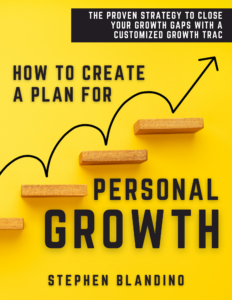
Practice #1: Growth TRACing – Creating, implementing, and monitoring your personal growth happens through the process of Growth TRACing (pronounced tracking). A Growth TRAC is like a personal growth plan that provides the framework and direction for your growth. It includes four ingredients: Target, Roadmap, Accountability, and Check-Ups.

Your Target is your personal growth goal—a carefully crafted statement that articulates in which area of life you want to grow. Your Roadmap includes the training, resources, coaching, and experiences you’ll leverage to reach your target (in other words, “how” you plan to grow). Accountability gives you the support to stay the course. And Check-Ups are the periodic evaluations where you measure progress and make midcourse corrections. Growth TRACing gives direction to your learning and ultimately produces growth traction.

Practice #2: Reflective Thinking – Reflective thinking is the habit of processing what you learn as you implement your Growth TRAC. It helps you mine for the gold in what you’re learning and typically requires three things: time, questions, and takeaways.

Setting aside think time is often perceived as a waste of time, yet it’s essential if you want to assimilate your learning into daily practice. This process begins by asking questions that help you make sense of what you’re learning. Your questions should then lead you to specific takeaways for application. While your Growth TRAC sets the course for your learning, reflective thinking helps you make that learning personal, applicable, and meaningful. Reflective thinking ultimately results in mental maturity.

Practice #3: Tenacious Application – The knowing/doing gap is the toughest to close but can actually happen when you put this “action equation” to work: Inner Resolve x Outer Support = Tenacious Application.

Inner resolve combines conviction and courage so you have the determination to act on what you’ve learned. Outer support is a combination of accountability and dependence. It taps ongoing accountability from others while being fully dependent on God for His strength. When you multiply inner resolve by outer support, the result is the tenacious application of the things you’re learning. Tenacious application helps you move from learning and thinking to actually doing. It ultimately results in personal transformation.

Continue Reading…

It’s that time of year again…New Year’s Resolutions. The thought exhilarates some people and completely deflates others. The fact that only 8% of Americans say they always reach their resolutions probably doesn’t help. So is it time to forget New Year’s resolutions? Or, better yet, maybe it’s time to figure out how to actually reach them.

It’s no secret that if you want to reach your dreams and maximize your potential, you have to close the gap between who you are and who you need to become. Facing your growth gaps is where your resolutions begin and your personal growth takes shape. But once you’ve identified your gaps, you need a Growth TRAC to run on. A Growth TRAC is how you create, implement, and then monitor your own plan for personal growth. It helps transition New Year’s resolutions from “what if” to “what is”. I’ve discovered four ingredients to an effective Growth TRAC: Target, Roadmap, Accountability, Check-ups.

Target: What are My Growth Goals?

A good Growth TRAC sets clear and specific goals, or TARGETS, that provide direction for your growth. While it’s natural to set goals in the weak areas of our lives, it’s also a shortsighted approach to personal growth. Good growth plans build on your strengths, manage your weaknesses, and address your liabilities.

  • Strengths are the areas where you demonstrate gifting, natural talent, passion, and successfully learned skills.
  • Weaknesses are those areas where God did not gift you, perhaps at all. For me “the short list” includes things like music, sports, mechanics, carpentry, science, math, and counseling (trust me, there are plenty more).
  • Liabilities are any behaviors, attitudes, or personality traits that cause (or could lead to) neglect in key areas of your life, prevent the fulfillment of God’s purpose for your life, or sabotage your character, integrity, or relationships.

Because you’ll make your greatest contribution through your strengths, it only makes sense to grow them to their full potential. Liabilities need attention so they don’t pull the rug out from under your life, relationships, and dreams. But weaknesses (as defined above) need only limited attention in your growth plan. Begin your Growth TRAC with clear Targets (or goals) that build on strengths and address liabilities in key areas of your life such as spiritual, mental, relational, and physical.

Roadmap: How Do I Plan to Grow?

The next step in a Growth TRAC is to create a roadmap that helps you get from point A (where you are) to point B (your defined Target). I’ve found four valuable stops in the ROADMAP of a good Growth TRAC.

  • Training includes classes, schooling, conferences, seminars, workshops, and other instructional opportunities.
  • Resources such as books, magazines, CDs, DVDs, podcasts, blogs, web-based tools and any other media that can transport new ideas into your thinking.
  • Relationships such as mentors, coaches, disciplers, family members, counselors, and close friends.
  • Experiences include opportunities, activities, or assignments that directly stimulate your growth.

Each of these “stops” in your Roadmap is essential to helping you reach your Target. Some are more natural than others depending on your unique personality type, but each offers tremendous value in personal growth. Work hard to include training, resources, relationships, and experiences in your Growth TRAC so that you can keep growing toward your dreams.

Accountability: Who Will Hold Me Accountable for My Growth?

This is the question we like to ignore. We tend to squirm when we hear the “A” word because we fear that all of our flaws and shortcomings will be seen under the bright lights of a friend’s questions. But if we’re honest with ourselves, we have to admit that none of us are good enough to grow alone. Draw from your current pool of relationships, and let your growth Target tell you who your accountability partners should be.

Check-Ups: When and How Will I Evaluate My Growth Progress?

Periodic check-ups help you stay focused and make mid-course corrections as you implement your Growth TRAC. To help incorporate Check-ups into your Growth TRAC consider the following:

  • Create a deadline for your Targets
  • Create a specific timeline (with start and finish dates) for each element included in your Roadmap
  • Enter every part of your Roadmap into the tool you use to manage your time and your schedule
  • Involve your Accountability partners in periodic check-ups to help you objectively evaluate your progress
Personal growth does not happen by accident. You need an airtight growth plan. That plan finds a unique, meaningful, and powerful framework in a Growth TRAC. To learn more about a Growth TRAC, how to leverage your personality type when creating a Growth TRAC, or to see samples of a Growth TRAC, check out my book, GO! Starting a Personal Growth Revolution. GO! is available on Kindle and from Amazon, Barnes & Noble, and Books-A-Million.
  

Multiplying Your Growth

September 15, 2012 — Leave a comment

The concept of multiplication isn’t new, especially in the world of leadership. While it may not happen as often as it should, most leaders understand that unless they move beyond the addition of workers to the multiplication of leaders, they will never maximize their potential, or the potential of the organization, ministry, or department they lead.

The same principle holds true with personal growth. You can grow yourself and even impact others, but multiplication is an entirely different level. In the same way a rock tossed in a pond creates a series of ripples, the Multiplying Level of personal growth initiates an enduring process of personal growth ripples. Those ripples form when you help somebody grow, and then they turn around and invest in the growth of others. At this level, personal growth revolutions spread and even have the potential to go viral.

My grandmother—Violet Morley—recently passed away at the age of 92. She wasn’t popular or famous or rich. You won’t find her name in the history books of earth. But you can be sure that her name is remembered in the halls of eternity. She was a deeply spiritual woman with an unwavering commitment to prayer.

I’m convinced that Grandma’s name was known in heaven and in hell—heaven because she spoke to Jesus daily, and hell because she fought the enemy fearlessly. She once told me, “We have to do many different things, but prayer is the main thing.”

On the day that she died, my mom told me that grandma’s life was like a ripple—an enduring set of prayer ripples. Those ripples were felt in countless lives as one friend and family member after another surrendered their lives to Christ. At her funeral, letters were read and messages were shared by people who grandma “prayed into the Kingdom.” On three separate occasions, those in attendance stood to their feet in applause of this tiny, insignificant lady who had a Mount Everest sized prayer life.

When I reflect on her prayer journey, I realize that she didn’t take the journey alone. She mentored others in prayer, and she passed her prayer habit on to future generations. Prayer was more than a personal habit. It was a multiplied habit. She might have been a little lady, but she grew and multiplied a contagious prayer life…in her, around her, and beyond her.

A great biblical example of the highest level of growth is found in the book of 1 Thessalonians. Paul, Silas, and Timothy express gratefulness in their letter to the church in the city of Thessalonica. After an initial greeting, they write:

For we know, brothers loved by God, that He has chosen you, because our gospel came to you not simply with words, but also with power, with the Holy Spirit and with deep conviction. You know how we lived among you for your sake. You became imitators of us and of the Lord; in spite of severe suffering, you welcomed the message with the joy given by the Holy Spirit. And so you became a model to all the believers in Macedonia and Achaia. The Lord’s message rang out from you not only in Macedonia and Achaia—your faith in God has become known everywhere. (1 Thessalonians 1:4-8)

I want you to see the personal growth ripples in this passage. It started with Paul, Silas, and Timothy when they said, “You know how we lived among you for your sake.” They began by living their growth. What they learned and thought transformed how they lived. Out of the overflow of personal transformation, they intentionally impacted the Thessalonians—“You became imitators of us and of the Lord…”

But the growth didn’t stop there. Multiplication kicked in: “And so you became a model to all the believers in Macedonia and Achaia. The Lord’s message rang out from you not only in Macedonia and Achaia—your faith in God has become known everywhere.”

What the Thessalonians received from Paul, Silas, and Timothy’s growth was more than an inspiring model that impacted how they lived. They were empowered to multiply that transforming work in the people around them. These men didn’t keep their growth a secret. Nor did the Thessalonians let the growth ripple end with them. They chose to invest in the believers in Macedonia and Achaia who then, invested in people “everywhere.” That’s exponential growth. That’s the power of multiplication. Paul, Silas, and Timothy’s personal growth started a growth revolution in people they never even met.

Question: What would have to happen for you to begin multiplying your growth through others?

This post was adapted from my book, GO! Starting a Personal Growth Revolution. You can order a copy in my store here or on Amazon or KindleGO! is also available from Barnes & Noble. For bulk orders, email me here.

7 City ChurchIn January 2012, Stephen and I began a journey to plant a church in an urban part of Ft. Worth, Texas called “West Seventh.” You can learn more about our church planting vision here. This endeavor began with Stephen developing a prayer list of 10 specific, bold prayers that we felt were essential for this church plant.

Number 8 on the list was a name for the church: “Pray that God will give us a name for the church that captures the heart and vision of the church and connects with our target audience.” By “target audience,” we mean the area where God has called us to serve. At the time we felt this prayer would come naturally and easily…we had no idea it would take 6 months!

Being a research nerd at heart, we decided to begin the process by examining how other churches developed their name. Unfortunately, there is little information published, but the few articles and blogs we found provided some great information to start with:

1. The Word “Church” - We wanted to have the word “Church” in our name. This was something that the research showed us as imperative. People like to know what type of business/industry/facility they are visiting. No reason to leave people wondering what is going on inside your building.

2. Geography - We did not want to be land-locked geographically to an area. We needed a name that would tie in with the greater community and allow us to relocate in the future without changing our name.

3. Avoiding Fads - We had to avoid cheesy, popular names of the moment. Although there are some great name ideas, we had been in youth ministry for 11 years and knew we did not want a name that would sound like a youth group. In addition, we hoped for a name that would last beyond our tenure.

4. Web & Social Media Dilemmas – We had to make sure Facebook, Twitter, website .com, .net or .org, and other social media names were available. For some names this was easy, for others not so much.

5. Short & Catchy - The name needed to be short and catchy – in other words “brandable”. I know we are not Starbucks or Apple, but having a short, concise, and catchy name makes it so much easier to develop a logo and signage and to communicate the name.

Our next step was to research names of healthy urban churches across the country. It was exciting to see so many churches doing what we hoped to do in Ft. Worth. I loved how many of the churches used the city’s culture or an unusual biblical reference to inspire their name.

This part of the research helped us funnel down our next step in the name. We really liked two words “city” and “urban” and wondered how we could use one of them in the church’s name? Urban is a great word and is being redefined in many parts of society, but after polling the word to different generations and researching urban logo designs, we really felt the word “City” would be a better fit. So now we had “City” and “Church”, but we still needed the hook word, that would help drive our vision.

Over the next few weeks, we would pray, toss out ideas, pray some more, toss out more ideas, research more, but unfortunately, we hit a wall and nothing felt right. I had a friend share with me that the right name would “feel like giving birth.” You would know it deep down and it would resonate with the church.

Late one evening in June, Stephen and I were sitting in bed with our laptops (nothing like church planter office hours) and we had been researching for over two hours. I remember the evening so clearly. Stephen was looking down when he quietly said “City Church”, “Seven City Church”. When he said this, I could feel it and sense it in my spirit…that was the name!  For the next few days we mulled over it and shared it with friends.

We were so excited – God had answered our prayer perfectly! Our vision is to see cities transformed by inspiring community and influencing culture. The word “Seven” captured our vision so clearly:

1. It helped tie us to the greater community that the church is located in without land locking us for future growth.

2. Seven means complete and perfect – our prayer is for Ft. Worth to be a complete and whole city.

3. There are 7 areas of culture we pray to influence – business, government, media, arts and entertainment, education, the family, and the social sector.

You can learn more about our vision for 7 City Church at www.7citychurch.com. Check out our Facebook and Twitter links too. And if you’re another church planter trying to find the right name for your church, hopefully our journey will be an encouragement to you.

This post was written by Karen Blandino. You can follow Karen on Twitter here or check out her Facebook page here.   


GO!

My New Book is Coming in August

I cannot tell you how excited I am about the upcoming release of my new book, GO! Starting a Personal Growth Revolution. Writing is both a calling and a passion for me, and the message in this book has been cooking inside of me for well over twelve years. I’m so glad to finally share it with you.

So What’s the Message?

Do you feel stuck? Is your personal growth on pause? Is the gap growing larger between where you are and where you want to be? Do you want to help others grow but you don’t know where to start? My new book equips you to unlock your personal growth and inspire a growth revolution in others.

Whether you’re just starting your growth journey, you’re a lifelong learner with an unquenchable appetite for growth, or you’re somewhere in between, GO! will help you to:

  • Identify and close the gap between you and your dreams
  • Access the three on-ramps to personal growth
  • Create a customized personal growth TRAC
  • Experience the power of the five levels of personal growth
  • Embrace the five GO! Practices that take personal growth to an entirely new level
  • Leverage your personality type to grow to your full potential
  • Make intentional investments in others by using six growth deposits

GO! will not only challenge you to grow yourself and the people you influence, but it will also equip you with the tools to turn growth potential into reality. Whether you’re a pastor, coach, teacher, leader, HR professional, student, or you simply want to take your personal growth to a new level, GO! is your roadmap to get there.

What Others Are Saying About GO!

“Some books are written to inform, and others to inspire, still others to motivate you to action. In GO! Starting a Personal Growth Revolution author Stephen Blandino does all three. You will learn, grow and move forward. The concepts are real-life and the strategies, if followed, will actualize your full capacity potential.”

- DR. SAMUEL R. CHAND, Leadership Coach, Consultant, and Author of Cracking Your Church’s Culture Code

“Anybody who wants to become all that God wants them to be has to read GO! Stephen hits the nail on the head on how we develop personally so that we can maximize our God given potential!”

- HERBERT COOPER, Lead Pastor, People’s Church, Oklahoma City

“In business I’m always looking for a competitive edge, and in GO! Starting a Personal Growth Revolution Stephen Blandino gives you that edge. Through the five levels of personal growth you create a pathway for personal growth both for yourself and the people you lead. This book is one you’ll actually implement the wisdom it contains.”

- BILL BARNETT, Nationally Syndicated Radio Host and the Best Selling Author of Are You DUMB Enough to be RICH?

I hope you’ll pick up a copy of GO! upon its upcoming release. If you want to get the latest news on my new book, sign up in the top right margin to get email updates.


Leading change is one of the most important things leaders do. Author and business expert John Kotter devoted an entire book on How to Lead Change. Pastor Brad Powell wrote a book on the Art of Sacred Cow Tipping called Changing Your Church for Good. It’s one of the greatest challenges in leadership today.

Recently I was reflecting on the change process that leaders navigate in organizational settings. While there are many elements in the change process, three steps are always necessary: Seeking Insight, Selling Ideas, and Securing Involvement.

  • Seeking Insight is all about gaining perspective, counsel, advice, and wisdom from other leaders. This is the research side of leading change. Without it, change initiatives usually fall short of their full potential and often result in diminished outcomes.
  • Selling Ideas is the vision-casting side of leading change. It focuses on painting a clear picture of a bright future and usually involves speeches, small group meetings, and one-on-one conversations to help people see the possibilities of the new change. The goal is to do more than push your agenda…it’s to inspire a shared vision.
  • Securing Involvement is where people accept your new idea and throw their time, energy, emotions, and resources behind the vision. This is the buy-in side of leading change.

There are four observations I’d like to make about this three-step process to leading successful change.

Continue Reading…

In the last few weeks I’ve had to do a great deal of vision casting…probably more than any other time in my life. On May 27th, Karen and I announced that we are planting a new church in the downtown/West 7th area of Fort Worth. You can read more here and view our vision video here.

In just a matter of weeks I feel like I’ve had more vision-casting breakfasts, lunches, dinners, coffee meetings, and gatherings than I can count. And the response has been overwhelmingly positive. We’ve been humbled as people have chosen to partner with us as we embark on this new journey.

Through this process, I’ve observed a few valuable lessons about vision and vision-casting. While I’m certainly not a Jedi master vision caster, here are four insights I’ve found particularly important.

1. The Process of Vision-Formation is Underestimated - The birthing of a vision in a leader’s heart is a often a raw mixture of pain, sweat, prayer, learning, editing, reflecting, and dreaming. Leaders have a biased toward action, and sometimes that bias trumps the vision-formation process. We want it quick and we want it now. While visions may form quickly, my experience is that the visions with the deepest roots often grows slowly over time. As I reflect on my own vision-formation process, I observe two things:

  • The values that shaped my vision have been “cooking” for over ten years.
  • The words that describe my vision have been “focusing” for over three years.

I’m not saying your vision-formation process has to take this long. But don’t rush it. In fact, there’s likely a deep connection between who God has been shaping you to be and what God is now calling you to do. That’s been the case for me. My vision has cooked for over ten years because during that period two major values formed inside of me. Those values shaped my vision and are now finding a new platform for expression. While impatience often tempted me to move quicker, I now see how perfect God’s timing is. If you’re struggling with the vision-formation process, here’s five thoughts to help you capture a vision.

2. The Fingerprint is the Game Changer in Vision - I cannot emphasize enough why this is so important. When leaders pop out a vision like it’s a bag of microwave popcorn, it usually lacks creativity and looks like a mass-produced, mind-numbing replica of another leader’s vision. We’ve heard it said a thousand times: vision is like a fingerprint. But my experience is quite the opposite. Most visions today look like they were formed by hands with melted fingertips…original prints are nowhere to be found.

If your vision has no uniqueness, creativity, or DNA that you can call your own, then you may have rushed through the process of vision formation. Remember, your vision needs substance. Fingerprints aren’t captured in water. They need a pliable surface where they are captured. Is your vision more like water or like clay?

Continue Reading…

Today we want to share with you some BIG NEWS! On Sunday, September 16th, 2012, Karen and I are launching a new church in the Downtown/West 7th area of Fort Worth, Texas. God has been preparing us for this transition, and we are humbled by the doors He has recently opened (Check out the video below to hear more).

In the past few years, thousands of people have returned to Fort Worth’s West 7th cultural arts district and the Downtown area. And in the coming years, Fort Worth will open a new river walk area around Downtown with room for 25,000 more people to move into the heart of the city. Voted as having one of the top 10 downtowns in the United States, Fort Worth is booming with housing, restaurants, and entertainment venues.

We have a vision to see cities transformed by inspiring community and influencing culture. Imagine a church that shapes the future of societies locally and globally. Imagine a church that mentors and mobilizes emerging generations to create the future. Imagine a church that redeems people to Christ and restores societies to their God-intended design. We know we cannot change a city alone. It takes a team of churches, leaders, and Christ-followers to see transformation in the heart of these cultural hubs. Together we can change a city.

We have already secured a building at 2900 W. Lancaster. This 14,800 square foot facility (pictured above) is strategically located in the heart of the action.

Surrounded by new condos and lofts, this building is only blocks away from restaurants, entertainment venues, museums, the Movie Tavern, and Montgomery Plaza in the West 7th area of Fort Worth.

Christ Church in Fort Worth, Texas is mothering the church (we’ll reveal the new church’s name soon). Pastor Darius Johnston and the Christ Church team have committed to support our launch to see a church planted in this growing area of Fort Worth.

We would like to invite you to partner with us in PRAYER, GIVING, and GOING to help launch this church:

  • PRAY - Click here to request our latest prayer list or to join our prayer team.
  • GIVE - Click here to make a secure donation via Christ Church’s online giving option – be sure to put “Downtown Church” in the “Other” description box.
  • GO - Click here if you’re interested in being a part of this new church or would like to request more information.

Thank you for your support as we move into this new chapter of our lives. We look forward to keeping you posted as our journey continues.


Author and leadership consultant Dr. Sam Chand observes in his book, Cracking Your Church’s Culture Code:

“People have an almost limitless capacity for self-deception. We don’t know what we don’t know and are therefore unconsciously incompetent. If we were aware of our deficits, we’d ask questions and find solutions, but because we’re not aware, we stay stuck in the status quo until something shakes us awake” (p. 41).

There’s an element of not knowing what we don’t know that sounds crippling, almost even hopeless. If you don’t know that you don’t know something, where do you even start? There’s obviously not a fool-proof answer to this question. In fact, the answer to your “how do I know what I don’t know” question isn’t what you don’t know. Confused?

There are thousands of “I don’t know what I don’t know’s” out there that I will never know. And I can’t frantically search for the answers I don’t even know that I need. Instead, the only way to deal with our unconscious incompetence is to cultivate a set of ingredients that make it easier, and more likely, to discover what I don’t know. What are those ingredients? I suggest five:

Continue Reading…