Your life is the result of your “inside decisions.” Inside decisions define your habits—whether good or bad. What happens on the inside manifests itself by your habits on the outside. In Colossians 1:9, the Apostle Paul writes,

“…we have not stopped praying for you and asking God to fill you with the knowledge of his will through all spiritual wisdom and understanding.”

This verse reveals a natural progression in the growth process: It begins first with knowledge, then moves toward spiritual wisdom and understanding.

The word Paul used for knowledge is epignōsis (eh-PIG-noh-sis). Author and professor Dr. William Yount (1996) describes epignōsis as “a knowledge that reaches out and grasps its object and is in turn grasped by its object.” What you learn becomes more than knowledge—it changes how you live. You grasp the knowledge, and the knowledge grasps you. It forms a new habit. Yount further observes,

“Epignōsis moves beyond mere head knowledge to what we might call ‘heart’ knowledge: a knowledge that affects the way we live. To be filled with the epignōsis of His will means to take hold of God’s Word, and allow God’s Word to take hold of us.” 

As this knowledge becomes understanding, it finds application—what Jesus calls “wisdom.” He says in Matthew 7:24, “Therefore everyone who hears these words of mine and puts them into practice is like a wise man who built his house on the rock.” (emphasis mine). Learning allows you to gain knowledge. Thinking allows you to understand that knowledge. Living is where you finally see it translated into wisdom—through application.

When you decide to apply what you’ve been learning, you walk right into new habits. You begin actually doing what you’ve been learning and thinking about. You leap from possibles to actuals. A debate rages inside you at the Thinking Level of personal growth? The Living Level silences it once and for all. The rubber meets the road. You’re committed. President John F. Kennedy once said:

“There are risks and costs to a program of action. But they are far less than the long-range risks and costs of comfortable inaction.”

You just passed the last exit for comfortable inaction. The risks of action are straight ahead.

When you adopt a new habit, there is evidence of a transformed life. Everything’s actually happening. You’re doing more than accumulating knowledge; now you’re applying its lessons to your everyday life. The things you decide aren’t just idealistic; they’re realistic. You’re practicing, implementing, and completely applying. Your knowing has become your growing. You’re no longer pointing to how you want to grow; now you’re pointing to the evidence that you are growing. Your learning feeds new habits (habits of the head, hands, and heart), which demonstrate a transformed life.

Personal transformation is difficult. Human beings resist change, and the process of forming new habits isn’t easy. And while we work hard to form new habits of the head (how we think) and new habits of the hands (what we do), changing habits of the heart is entirely different.

Your heart represents the very core of who you are, which is why it’s the hardest thing to change in your life. The best way—in fact, the only way—to reach true, honest, heart transformation is to allow the Spirit of Christ to do the transforming. If you try to just “do” the right behaviors without God’s Spirit changing you on the inside, you’ll find yourself with little more than two legalistic lists: Do’s and Don’ts. Don’t do that to yourself.

Your Work (the discipline) x God’s Work (the transformation) = Exponential Life Change

The writer of Hebrews chastised the Hebrew Christians for being “slow to learn.” (Hebrews 5:11) He wasn’t criticizing their mental abilities. It was their spiritual laziness that was the problem. They were resisting the path to maturity by staying on “milk” instead of moving up to “solid food.” Hebrews 5:14 says, “But solid food is for the mature, who by constant use have trained themselves to distinguish good from evil.” To get that maturity, you have to fully trust Christ and practice personal application through disciplined intentionality.

Notice that both “constant use” and “training yourself” are required. In fact, Jesus said,

“If you just use my words in Bible studies and don’t work them into your life, you are like a stupid carpenter who built his house on the sandy beach. When a storm rolled in and the waves came up, it collapsed like a house of cards” (Matthew 7:26–27, MSG).

Did you catch that? You have to “work” God’s word into your life. New habits don’t form by themselves. Learning without applying what you have learned is just plain laziness. Lazy Learning = Lukewarm Living.

We must do what we can do (the discipline), and let God do what only He can do (the transformation). The Apostle Paul described God’s transforming work when he challenged the church at Ephesus to abandon their old way of life, inviting them instead to “take on an entirely new way of life—a God-fashioned life, a life renewed from the inside and working itself into your conduct as God accurately reproduces his character in you.”

What an amazing picture. Take a moment to imagine what it might look like for God to “reproduce his character in you.” No matter how much you have your act together, you’ll never be able to take the place of God. Reproducing His character inside of us is God’s job, not yours or mine. Our job is simply to trust Him and cooperate with His Spirit.

If you consider yourself a follower of Christ, but you’re not willing to allow Him to transform you, then you’re what Craig Groeschel calls a “Christian atheist”: you believe in God, but you live as if He doesn’t exist. And if you’ve never surrendered your heart to Christ, are you willing to take that step? Are you willing to say “yes” to the transforming work of the Holy Spirit when He comes to live inside of you? A fully devoted “yes” to Christ’s transforming work will turn your personal growth efforts into a powerful makeover of the soul.

Question: What needs to happen to move beyond good intentions and actually see transformation take place in your life?

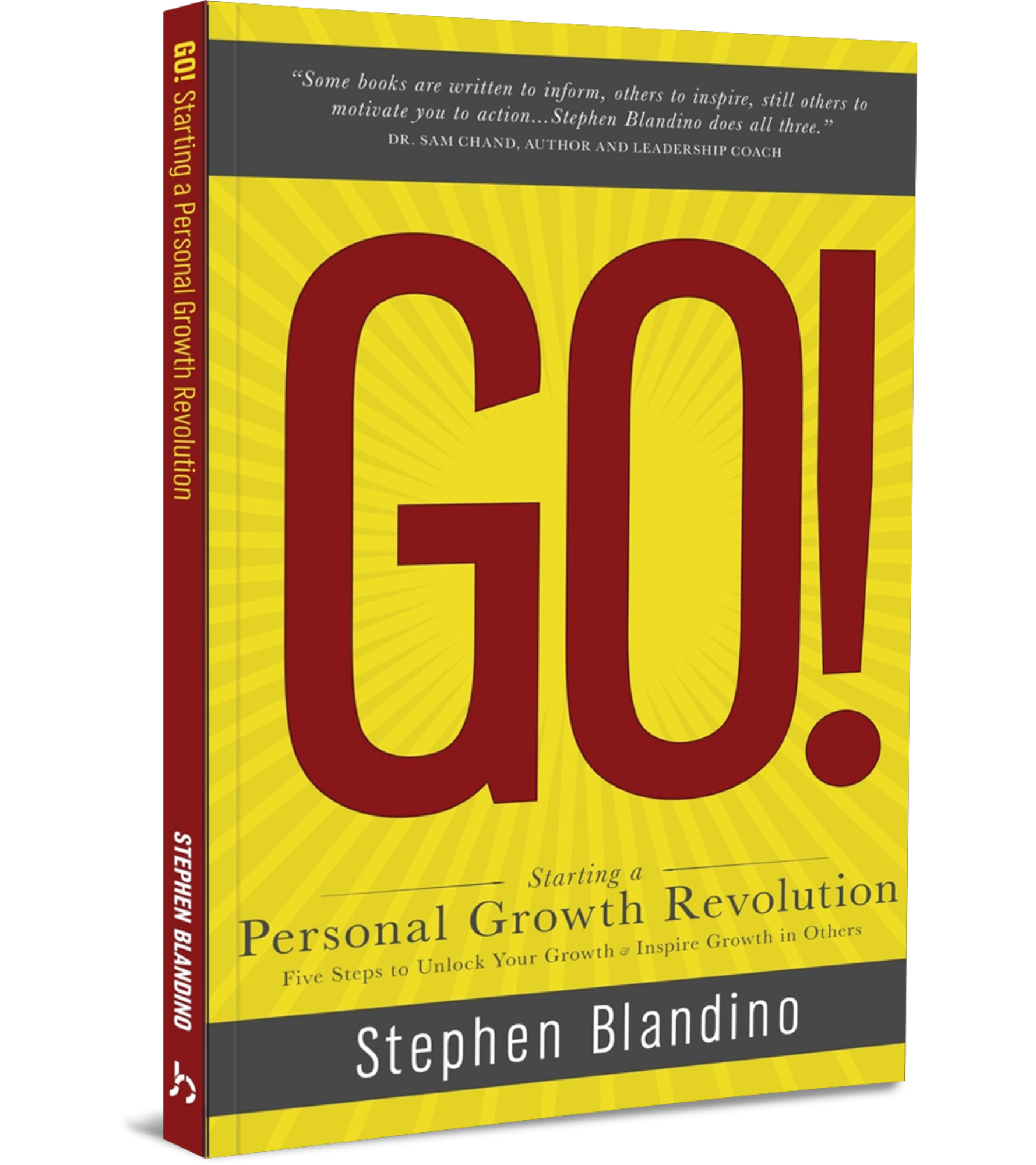
This post was adapted from my book, GO! Starting a Personal Growth Revolution. You can order a copy in my store here or on Amazon or KindleGO! is also available from Barnes & Noble. For bulk orders, email me here.


The formation of beliefs and assumptions is a lot like a seesaw—you might have called it a teeter-totter as a kid. When you and your buddy sat on a teeter-totter, you would soar into the air as your feet launched you upward, and then, just as quickly, sink downward as your friend’s feet left the ground. While the up and down motion felt exhilarating, and perhaps even unsettling at times, your confidence was grounded in one thing—the base at the center of the seesaw. No matter how quickly you pushed up and how hard you came down, you knew the base wasn’t going anywhere. It was your anchor.

In personal growth, thinking is the mental teeter-totter at work. On one end of the seesaw are ideas, on the other end are practices, and in the middle—serving as the base—are absolutes.


Thinking Seesaw

Ideas are insights for living. They can fill your mind rapidly as you read great books, hear inspiring speeches, explore creative environments, or interact with wise mentors. As you activate a personal growth plan, there’s a good chance your mind will be saturated by fresh ideas in the areas of your life where you’ve chosen to grow. Some of these ideas will be proven, but others will be more like theories waiting to be tested as a practice.

Practices are strategies for achieving. If you’ve been around business for any length of time, you’ve probably heard the phrase, “best practices.” Best practices are those methods of doing business that are considered to deliver the best results. They are usually proven strategies for achieving the highest levels of success. There are also “best practices” in other areas of life too—spiritually, mentally, relationally and physically. And as you engage in lifelong learning, you’ll likely uncover some of these best practices in the areas where you’ve chosen to grow.

Ideas and practices freely move up and down on each side of the thinking seesaw. Your mental feet leave the ground as you learn new ideas and experiment with new practices. This flexibility keeps false assumptions and misinformed beliefs from becoming entrenched in your thinking. Eventually you’re able to settle on ideas and practices that actually work and leverage them to help you close your growth gaps.

I was working with a team of leaders a while back when we decided to evaluate the effectiveness of our small group ministry. We spent six weeks meeting together to take a hard look at our strengths and weaknesses, as well as ways to improve. This process allowed us to bring our ministry assumptions under the microscope. The mental teeter-totter was aggressively moving up and down as we examined fresh ideas and best practices.

At first it almost felt like chaos, unsure where things were going to land. The longer we sat on the thinking seesaw, the more exciting ideas we collected—several of which were untested—and the more we observed powerful best practices. But eventually we settled on a handful of ideas and practices—a refined model—that increased the health of our small groups. None of that would have been possible had we not been willing to challenge our assumptions and get comfortable with letting our feet leave the ground.

Are there areas of your life where you’ve abandoned the seesaw? Why not get on the teeter-totter once again as you put your growth plans to work. After all, what’s the point of crafting a growth plan if you’re not willing to challenge your long-held assumptions? Don’t be scared of the up and down motion—it’s necessary, even indispensable, if you want to gravitate toward the ideas and practices that will actually help you grow. This process is unsettling at times, which is why you need the security of your seesaw’s base—absolutes.

While ideas and practices are key components to challenging assumptions and forming beliefs, it’s important to remember that they are not absolutes. Absolutes are anchors of belief. Absolutes are the base of the seesaw. They are fixed—immovable. Absolutes are non-negotiable truth that does not change regardless of time, culture, or geography. In fact, absolute truth originates outside of yourself. Whether or not you believe absolutes does not change the fact that they’re still true. Absolutes don’t need your or my permission to be the truth—they stand as truth just fine regardless of our opinion. Absolutes are fully trustworthy and apply to everybody. They serve as the litmus test before embracing new beliefs, engaging new practices, or deeming a new idea as worthy of pursuit.

As human beings, we tend to drift toward the path of least resistance. If we’re not careful, we’ll adopt ideas and practices that are culturally acceptable, yet violate absolute truth. As you field-test ideas and practices, absolute truth keeps you grounded and helps you avoid the dangerous lure of deception. For this reason, I’ve adopted Original Truth—the Bible—as my source for absolute truth.

What is the base, the immovable absolutes, of your thinking seesaw? Without a rock-solid base, your ideas (those insights for living) and your practices (those strategies for achieving) will do more than keep you culturally relevant, they will ever so slowly mislead you.

When absolutes are firmly established as the base for your thinking, you can easily challenge your assumptions and beliefs. You can bring the ideas and practices—those things you’re gleaning in your learning journey—into the light where you can examine their validity. And you can climb onto the thinking seesaw—grounded in absolute truth—where you can continually explore fresh ideas and best practices.

Embracing absolutes does not mean you’ll live a sinless life. I believe Scripture is absolute truth, but I struggle every day to live that truth. I’m far from perfect. I sin. It’s a daily battle. But having a firm base to anchor my life and thinking to keeps me calibrated in the right direction. Without the base, my life would be nothing more than a soupy mess of misguided philosophies. Even the Apostle Paul said, “See to it that no one takes you captive through hollow and deceptive philosophy, which depends on human tradition and the basic principles of this world rather than on Christ” (Colossians 2:8).

At the Thinking Level of personal growth, beliefs are challenged and formed by learning new ideas and embracing best practices while allowing absolutes to serve as the final authority. Keep these three things in perspective.

Question: Are you leveraging the thinking seesaw to keep your mind fresh and your life relevant. What is the base of your thinking seesaw?

This post was adapted from my book, GO! Starting a Personal Growth Revolution. You can order a copy in my store here or on Amazon or KindleGO! is also available from Barnes & Noble. For bulk orders, email me here.


When I was in high school I made the wrong choice—I only learned when I had to, and just enough to get by. The only thing I went out of my way to learn was shortcuts. I didn’t cheat, but I also didn’t apply myself. I was typically content with Bs and Cs (even the occasional D or F). I rarely put in the time or effort to do better. One reason was that I hated reading. It didn’t matter what kind of reading—novel, history book, short story—reading was not my thing. Unlike my wife, who grew up with a steady diet of books, I restricted my reading to TV Guide. Reading drained me. And most of what I read was boring.

College could have opened my eyes to reading, but no way I was going to let that happen. Throughout most of college, I only cracked half of my textbooks. (Nothing like spending dad’s money to buy books you never read.) It wasn’t that I couldn’t read—I just didn’t like to. Turns out, I wasn’t alone. Only 45% of Americans over the age of 13 read a book in the course of a year.

After graduating college with all the answers, it took me a couple of years to realize just how little I actually knew. In fact, those first two years of ministry were…how should I say this?…an experiment in stupidity. I alienated people, made dumb decisions, had a negative attitude, and was extremely naïve. Once my pastor tried to buy me a book on attitude. Ironically, I was offended. As if all those things weren’t enough, I once burned a hole in a church pew with a flash pot gone bad—less than 12 months after we had just remodeled the auditorium. Forrest Gump’s famous words encapsulated my life: “Stupid is as stupid does.”

When I finally realized how well prepared I was for irrelevance, that newfound humility forced me into a learning mode. I had come face-to-face with my growth gaps, and humility was the only road to change.

In the years that followed—mostly out of necessity—I developed a habit of reading. At first it was slow and inconsistent. I’d pick up a book here or there and occasionally read a magazine article. I can still remember reading John Maxwell’s early leadership book, Developing the Leader Within You, and thinking, “This is the best leadership book I’ve ever read.” Suddenly it occurred to me: “This is the only leadership book I’ve ever read.”

But that book, along with others, was a spark that ignited personal growth in my professional life. A subtle, but powerful, revolution had begun. I made a decision to grow. I took to heart the words of Mark Twain: “The man who does not read good books has no advantage over the man who cannot read them.” And I discovered a simple truth—with every page I read, my appetite for personal growth grew.

Today I’m an avid reader, but more importantly, I’m a lifelong learner. I made a decision to let my missional potential drive my learning, and then I followed that decision with one baby growth step after another. What about you? Would the people who know you well describe you with the phrase “lifelong learner”? If not, that can change. But you have to make a decision to grow.

As simple as it sounds, many people never make that decision. It won’t happen if you just wait for life and your circumstances to demand that you grow—like I did when I started in ministry. Mediocrity is tempting, because it’s easy to just take a seat in someone else’s ride and let your potential lie dormant inside of you. But if you choose to cruise through life in the passenger seat, learning only when you have to, then your growth won’t be on your terms. To truly grow into your potential, you have to decide to pick out your own car and head out onto the open road. That’s where the action is.

The true test of whether your decision sticks will be the behavior that follows it. But you won’t start until you first make a clear-cut, uncompromised decision. Revolutions start with “Go!” Your life today is the sum total of all your decisions. That means that your decision about personal growth today will greatly determine your life tomorrow.

Don’t take this decision lightly. And once you’ve made it, you’ll still have to manage it daily. Growth is a posture, not just a phase you go through. A phase lasts for a season and then it’s over. But a posture is an attitude. Your decision to grow is more than a single act of growth—it’s a frame of mind and a lifestyle of continual improvement.

So, let me ask you one more time—have you made that choice? Have you decided to become a lifelong learner, to set aside the “easy” life of mediocrity and grow to your full missional potential? If you haven’t, stop right now and make your choice. Don’t just flirt with the decision—marry it!

Question: Have you made the decision to be a lifelong learner?

This post was adapted from my book, GO! Starting a Personal Growth Revolution. You can order a copy in my store here or on Amazon or KindleGO! is also available from Barnes & Noble. For bulk orders, email me here.

All personal growth requires humility. Without humility, pride takes the wheel and aims for the ditch. History is littered with the pages of brilliant and talented men and women who were ultimately destroyed by their own pride.

Humility reveals our humanity. Let that idea really take hold in your mind. Humility reveals your humanity by keeping your failures and your successes in proper perspective to each other. Humility makes you teachable, a constant reminder of how much you need lifelong learning.

Abraham Lincoln, an avid reader and voracious learner, understood the importance of humility. When some editors were preparing a directory of congressmen, they asked Lincoln to submit his biography. He humbly wrote, “Education defective.” He was keenly aware that even though he had closed many of his personal growth gaps, humility was still the key to all future learning.

When we lack humility, our pride builds our knowledge into monuments of our own greatness. Although we can’t see it at the time, those monuments are actually barriers and roadblocks to our future learning. Humility, on the other hand, is like the gatekeeper to growth—and its gates are always open. If we begin to value what we’ve already learned over what we have yet to learn, those gates slam shut, sealed tight with the padlock of pride. Your current knowledge cannot be the permanent watermark for your future. Past learning does not guarantee future growth.

In the Beatitudes, Jesus was crystal clear about the importance of humility. Matthew 5 begins, “Blessed are the poor in spirit, for theirs is the kingdom of heaven.”(Matthew 5:3) Professor and author Bruce Winston (2002) observes:

“‘Poor in spirit’ is a state of being opposite of ‘rich in pride.’”

Winston says that we should not view ourselves as a full cup—something that cannot receive more—but rather as an empty cup, always willing to learn more from others. Humility reminds us just how empty our cup really is. Humility helps us remember that what filled our cup yesterday won’t continue to fill our cup today.

Humility calls us to increasingly depend on God, acknowledging that His infinite wisdom far surpasses our finite minds. Proverbs 1:7 captures it best:

“Start with God—the first step in learning is bowing down to God; only fools thumb their noses at such wisdom and learning” (MSG).

Bowing implies submission, respect, honor, reverence, and humility. Without this lifelong learning posture of the heart, we’ll enthrone our knowledge as an idol and turn God into our footstool. Humble yourself! Doing so will give you the attitude you need to grow for a lifetime and ultimately close your growth gaps. Is your posture bent toward humility? Or are you drowning in the glory of your own press release?

What’s the easiest way to cultivate humility? It’s simple: shut up! Seriously. We all like to talk about ourselves. The problem is, so does the person we’re talking to. When you put a verbal zip tie on your mouth, it might surprise you how much more people will enjoy hanging out with you.

Question: How does humility shape your personal growth journey?

This post was adapted from my book, GO! Starting a Personal Growth Revolution. You can order a copy in my store here or on Amazon or KindleGO! is also available from Barnes & Noble. For bulk orders, email me here.


All of us have growth gaps. My friend Steve Moore refers to these gaps as our “capacity challenge.” The capacity challenge is the gap between the person you are today and the person you must become to reach your dreams. The following diagram best illustrates your ultimate God-given capacity, how much of your potential is being reached, and the remaining gap between the two.

Growth Gap

Capacity defines what a person can contain. It is the total of your God-given potential. In the same way a milk carton has the capacity to hold a gallon of milk, God created every one of us with a specific capacity. In some areas of life, your capacity is like a gallon, in others it’s like a quart, and in still others it’s like a pint. Put simply, your strengths are greater in some areas than others.

The more you understand your greatest strengths (how God uniquely designed you), the more you will understand where you have the largest capacity for personal growth.

Let me give you some personal examples. My capacity for leadership is greater than my capacity for basketball. My capacity for teaching is far greater than my capacity for music. My capacity for writing exceeds my capacity for counseling. No matter how hard I work to grow the low-capacity areas of my life, my performance in these areas will only marginally improve. In areas of weakness, I am limited by a very low capacity ceiling. It’s not a matter of effort or desire. It’s completely a matter of capacity.

If I acquired leadership coaching, my leadership abilities could grow by say, 20 percent. However, no matter how many basketball camps I diligently participate in, I will never excel on the basketball court. Simply stated, my capacity for growth in leadership, teaching, and writing will always outperform my capacity for basketball, music, and counseling. The same is true for you:

The gifts and passions God builds in to you define the areas where you have the greatest capacity and aptitude for growth.

Your growth gap is like the half-full cup in the diagram above. The size of your gap is felt the most when you understand your present state…that is, how much of your potential you’re currently reaching. The cup might have the capacity to hold twelve ounces, but your present state may show you reaching only 40 percent of your potential. This is a crucial point to understand: just because your life has capacity for growth doesn’t mean it will automatically be filled to capacity.

Many people go through life with the capacity to do far more than they’re currently even trying. They’re only realizing half of their potential because they haven’t developed the other half. Only by developing ALL of our potential can we reach our full God-given capacity and, ultimately, fulfill the mission He created us for. When you grow consistently, you’re closing the gap between being half-full and being filled to the brim.

The gap is a reality in all of our lives. Nobody is immune to the gap, but how people respond to it is as diverse as the gap itself.

Some people don’t even recognize that a gap exists. They struggle with nearsightedness, walking obliviously past every opportunity to grow. Others acknowledge the gap in some areas of their life but ignore it in others. They grow cafeteria style, thinking, “I’ll take a little bit of this and a little bit of that.” Still, others take their growth gaps seriously, choosing to grow on purpose in strategic areas of their life.

Think about the faces of the growth gap in your own world. Why can some of your business friends grow thriving companies…and others can’t? How come some of your kids’ teachers create powerful learning moments in their classrooms while others do nothing more than count the minutes until the next bell rings? Why do some pastors break growth barriers while others remain trapped under a lid? Believe it or not, it’s not about desire—it’s all about reaching God-given capacity. The individuals who consistently achieve superior outcomes choose to close the gap between who they are and who they must become. In other words, they face their personal growth gaps head-on and pay the price to close them.

Questions: What are the growth gaps you’re facing right now? What is one step you could take to positively respond to your gaps?

This post was adapted from my book, GO! Starting a Personal Growth Revolution. You can order a copy in my store here or on Amazon or KindleGO! is also available from Barnes & Noble. For bulk orders, email me here.


7 Days of Growth

September 4, 2012 — Leave a comment

GO!I’m excited to announce the release of my new book, GO! Starting a Personal Growth Revolution. You can learn more HERE or purchase a copy in my store HERE or on AMAZON HERE. For bulk orders and pricing, email me HERE.

To celebrate the release of the book, I’d like to invite you to participate in 7 DAYS OF GROWTH. Beginning Sunday, September 9th I’ll release a new post on my blog for 7 days featuring content from my book. Each day will challenge you with a practical component to growth and help you leverage personal growth within you and around you. Plus, you can share your thoughts and ideas on each post and benefit from the observations of others too.

How Do I Sign Up?

To receive “7 Days of Growth” simply sign up for my blog (See the pop up bar at the bottom of this page). Then each post will be delivered directly to your email inbox. Plus, when you sign-up for my blog, you’ll be able to download the first two chapters of my book.

GO! is for anyone who wants to unlock their personal growth or inspire growth in others. If you feel stuck, don’t know how to close the gap between where you are and where you want to be, want to maximize your own growth, or want to learn how to help others growth, then GO! provides you the roadmap to get there. GO! will equip you to:

  • Close the gap between your reality and your dreams
  • Access the three on-ramps to personal growth
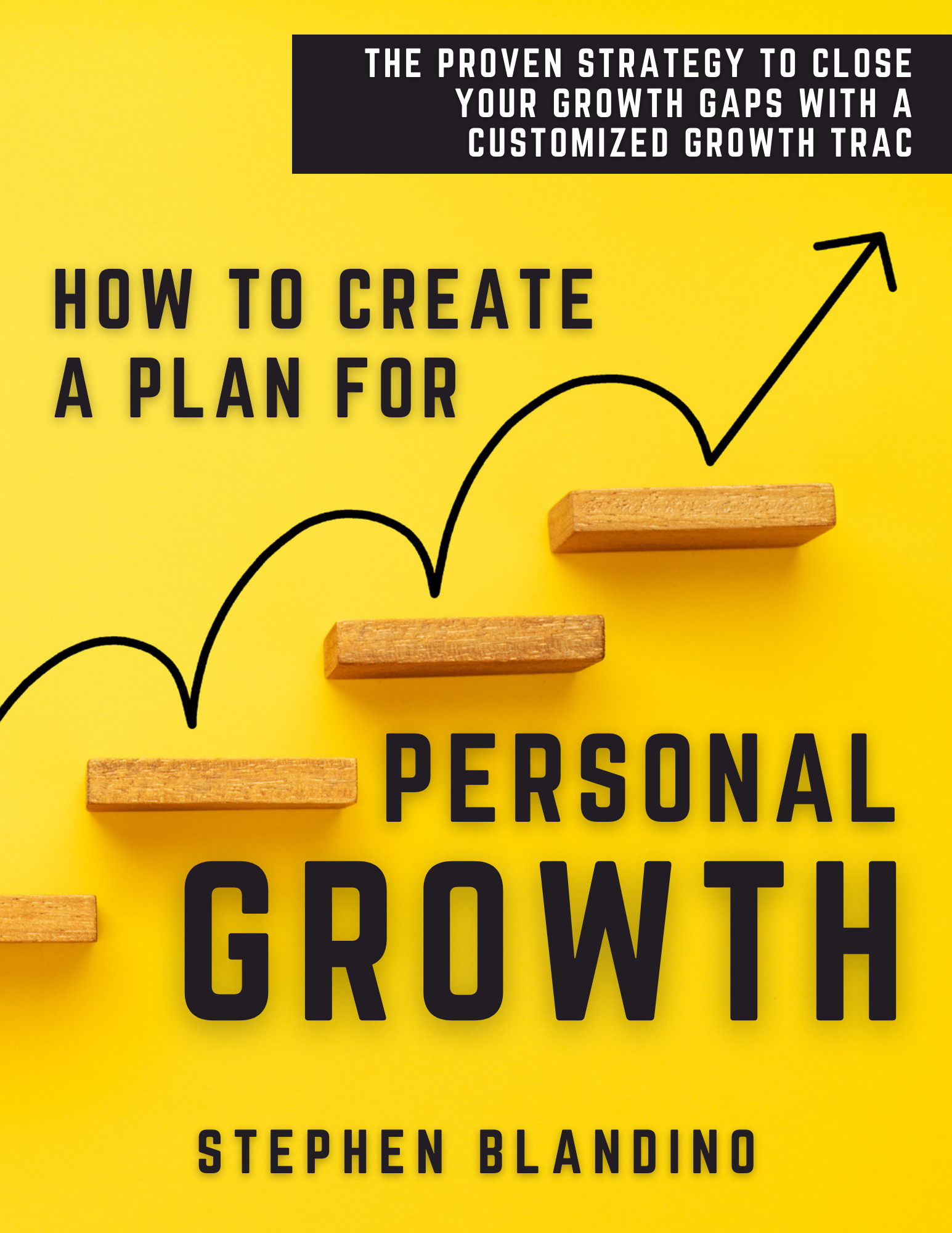
  • Create a customized personal growth TRAC
  • Leverage the five levels of personal growth to start a growth revolution in you, around you, and beyond you
  • Transform your thinking, move beyond good intentions, and experience personal transformation 
  • Maximize your personality type to grow to your full potential
  • Make intentional investments in others by using six growth deposits
  • Multiply your personal growth for continual impact

GO! is packed with inspirational stories, practical insight, and applicable ideas. Whether you’re a pastor, coach, leader, HR professional, student, or you simply want to take your personal growth to a new level, GO! will help you take your next step.

What Others Are Saying About GO!

“Some books are written to inform, and others to inspire, still others to motivate you to action. In GO! Starting a Personal Growth Revolution author Stephen Blandino does all three. You will learn, grow and move forward. The concepts are real-life and the strategies, if followed, will actualize your full capacity potential.”

- DR. SAMUEL R. CHAND, Leadership Coach, Consultant, and Author of Cracking Your Church’s Culture Code

“Anybody who wants to become all that God wants them to be has to read GO! Stephen hits the nail on the head on how we develop personally so that we can maximize our God given potential!”

- HERBERT COOPER, Lead Pastor, People’s Church, Oklahoma City

“In business I’m always looking for a competitive edge, and in GO! Starting a Personal Growth Revolution Stephen Blandino gives you that edge. Through the five levels of personal growth you create a pathway for personal growth both for yourself and the people you lead. This book is one you’ll actually implement the wisdom it contains.”

- BILL BARNETT, Nationally Syndicated Radio Host and the Best Selling Author of Are You DUMB Enough to be RICH?

“Stephen takes the mystery out of personal growth. He shows me how to be intentional about growth in my own life, and also how I can help others (my family, friends, mentees, so on) develop as well. GO! Starting a Personal Growth Revolution is full of the most practical wisdom you’ll find anywhere.”

- STEVE MOORE, President, Missio Nexus, and Author of Who Is My Neighbor? Being a Good Samaritan in a Connected World

“Stephen is onto a much needed step-by-step approach to personal growth. Packed with stories, GO! is a great read embedded with a number of life-changing practices. I came away with several practical next steps and I’m sure you will too!”

- MARK HOWELL, Small Group Ministry Consultant & Coach

“I have had the privilege to know and work with Stephen Blandlino for over 25 years. One constant during these years has been Stephen’s commitment to personal growth. His personal journey has now been encapsulated into this outstanding work to help each of us overcome our growth gaps. This is a must read!”

- DARIUS JOHNSTON, Lead Pastor, Christ Church, Fort Worth, Texas

“If personal growth and development seems mysterious to you, or if achieving sustained meaningful growth has eluded you, this book has the keys that can help you unlock your true growth potential! Five clear and powerful steps will put you on TRAC to live the life you have always wanted to live, realize your full potential and help others reach their full potential. Start your Growth Revolution today!”

- JERRY HURLEY, Team Development Leader, LifeChurch.tv

GO! Starting a Personal Growth Revolution is available in my store HERE or on AMAZON. For bulk orders and pricing, email me HERE.


GO!

My new book, GO! Starting a Personal Growth Revolution has officially released. You can purchase the book in my store HERE or on AMAZON.

GO! unpacks the five levels of personal growth so that you can maximize your own growth and intentionally invest in the growth of others. You’ll learn how to close your growth gaps, how to access the on-ramps to personal growth, how to create your own customized, personal growth TRAC, and how to see transformation in your life.

You’ll also discover how to leverage six growth deposits so that you can help others grow to their full God given potential. You’ll even learn how to multiply your growth through others.

GO! is a great book to use for:

  • Personal growth and reflection
  • Small group discussions
  • Leadership Development
  • Creating personal growth plans
  • Mentoring others
  • Staff development

To learn more or to see who has endorsed GO! click HERE. You can purchase the book in my store HERE or on AMAZON. For bulk orders and pricing, email me HERE.

GO!My new book, GO! Starting a Personal Growth Revolution will be out in just a few weeks. This book equips you to unlock your personal growth and inspire growth in others. You can learn more about the book, and who has endorsed the book, right here.

I’d like to ask for your help

I really believe this book can help many people close the gap between who they are and who they want to become. I believe it will help readers reach their God-given dreams, maximize their personal growth, and invest in the growth of others. But I need your help to spread the word.

I’m inviting 50 bloggers to review my new book on their blog and to receive an extra copy to give away to one of their readers. If you’re a blogger, here’s how you could win two copies of my book:

  • Apply here by August 24th (it’s fast and simple)
  • Write a review of the book on your blog between September 7th and September 30th
  • Give away your second copy of the book to one of your blog readers. Be creative.

I’ll select up to 50 bloggers from those who apply and will send each of them two copies of my book.

So what else is in it for you?

Good question! In addition to the two copies of my book, I’ll select one blogger to receive a free personal one-hour coaching call and I’ll select one blogger to share a guest post on my blog with links back to your blog (article is subject to my approval).

If you can help me spread the word, join my blog tour or retweet or like this post. And if you know a blogger who might be interested, feel free to share this post with them. Thanks for your help.


Mark your calendars now for the launch of 7 City Church on Sunday, September 16th, 2012. We’ll have two services at 9:30 and 11:00 am.

7 City Church - Launch Invite

For more information, visit us on Facebook, Twitter, Google+, Pinterest, YouTube, Vimeo or online at www.7citychurch.com. 7 City Church is located in the West 7th area of Fort Worth (corner of Currie and W. Lancaster – 3 blocks from the Movie Tavern).

7 City Church Map


As we prepare to launch 7 City Church on Sunday, September 16th at 9:30 and 11:00 am, our team has been working hard to develop a social media campaign. One of our team members, Heather Baker, put together a Social Media Guide for Facebook, Twitter, Pinterest, Google+, YouTube, and Vimeo.

This guide is a basic introduction to each of these social media sites and is designed to help you get the word out about 7 City Church. So do us a favor, download the Social Media Guide, and then start liking/following/commenting,pinning/sharing at each of our 7 ways to connect with 7 City Church online:

Website: www.7CityChurch.com

Facebook: www.facebook.com/7citychurch

Twitter: www.twitter.com/7citychurch

Pinterest: www.pinterest.com/7citychurch

Google+: http://gplus.to/7citychurch

YouTube: www.youtube.com/7citychurch

Vimeo: www.vimeo.com/7citychurch

Thanks for helping us get the word out about 7 City Church. And if you want to request more information about 7 City Church or would like to join our team, you can do so here.