Archives For leadership development

It’s that time of year again…New Year’s Resolutions. The thought exhilarates some people and completely deflates others. The fact that only 8% of Americans say they always reach their resolutions probably doesn’t help. So is it time to forget New Year’s resolutions? Or, better yet, maybe it’s time to figure out how to actually reach them.

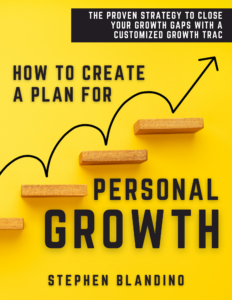
It’s no secret that if you want to reach your dreams and maximize your potential, you have to close the gap between who you are and who you need to become. Facing your growth gaps is where your resolutions begin and your personal growth takes shape. But once you’ve identified your gaps, you need a Growth TRAC to run on. A Growth TRAC is how you create, implement, and then monitor your own plan for personal growth. It helps transition New Year’s resolutions from “what if” to “what is”. I’ve discovered four ingredients to an effective Growth TRAC: Target, Roadmap, Accountability, Check-ups.

Target: What are My Growth Goals?

A good Growth TRAC sets clear and specific goals, or TARGETS, that provide direction for your growth. While it’s natural to set goals in the weak areas of our lives, it’s also a shortsighted approach to personal growth. Good growth plans build on your strengths, manage your weaknesses, and address your liabilities.

  • Strengths are the areas where you demonstrate gifting, natural talent, passion, and successfully learned skills.
  • Weaknesses are those areas where God did not gift you, perhaps at all. For me “the short list” includes things like music, sports, mechanics, carpentry, science, math, and counseling (trust me, there are plenty more).
  • Liabilities are any behaviors, attitudes, or personality traits that cause (or could lead to) neglect in key areas of your life, prevent the fulfillment of God’s purpose for your life, or sabotage your character, integrity, or relationships.

Because you’ll make your greatest contribution through your strengths, it only makes sense to grow them to their full potential. Liabilities need attention so they don’t pull the rug out from under your life, relationships, and dreams. But weaknesses (as defined above) need only limited attention in your growth plan. Begin your Growth TRAC with clear Targets (or goals) that build on strengths and address liabilities in key areas of your life such as spiritual, mental, relational, and physical.

Roadmap: How Do I Plan to Grow?

The next step in a Growth TRAC is to create a roadmap that helps you get from point A (where you are) to point B (your defined Target). I’ve found four valuable stops in the ROADMAP of a good Growth TRAC.

  • Training includes classes, schooling, conferences, seminars, workshops, and other instructional opportunities.
  • Resources such as books, magazines, CDs, DVDs, podcasts, blogs, web-based tools and any other media that can transport new ideas into your thinking.
  • Relationships such as mentors, coaches, disciplers, family members, counselors, and close friends.
  • Experiences include opportunities, activities, or assignments that directly stimulate your growth.

Each of these “stops” in your Roadmap is essential to helping you reach your Target. Some are more natural than others depending on your unique personality type, but each offers tremendous value in personal growth. Work hard to include training, resources, relationships, and experiences in your Growth TRAC so that you can keep growing toward your dreams.

Accountability: Who Will Hold Me Accountable for My Growth?

This is the question we like to ignore. We tend to squirm when we hear the “A” word because we fear that all of our flaws and shortcomings will be seen under the bright lights of a friend’s questions. But if we’re honest with ourselves, we have to admit that none of us are good enough to grow alone. Draw from your current pool of relationships, and let your growth Target tell you who your accountability partners should be.

Check-Ups: When and How Will I Evaluate My Growth Progress?

Periodic check-ups help you stay focused and make mid-course corrections as you implement your Growth TRAC. To help incorporate Check-ups into your Growth TRAC consider the following:

  • Create a deadline for your Targets
  • Create a specific timeline (with start and finish dates) for each element included in your Roadmap
  • Enter every part of your Roadmap into the tool you use to manage your time and your schedule
  • Involve your Accountability partners in periodic check-ups to help you objectively evaluate your progress
Personal growth does not happen by accident. You need an airtight growth plan. That plan finds a unique, meaningful, and powerful framework in a Growth TRAC. To learn more about a Growth TRAC, how to leverage your personality type when creating a Growth TRAC, or to see samples of a Growth TRAC, check out my book, GO! Starting a Personal Growth Revolution. GO! is available on Kindle and from Amazon, Barnes & Noble, and Books-A-Million.
  

Good coaching is significantly shaped by your ability to ask good questions. Because coaching is more about “drawing out” than “pouring in”, it is essential that you leverage question-asking to mine for the gold inside of your team members. Jesus was a master at coaching with questions.

Obviously the questions you ask vary based on the situation, as well as the responses, you are given. However, questions are not the only ingredient in a coach’s arsenal. “Coaching Phrases” are equally important. Here are three that I find particularly helpful:

1. “Unpack That For Me” - This is one of my favorite phrases. When I’m talking with a team member, I’ll often use this phrase after they’ve shared an idea, observation, or struggle. This is a great phrase to use when the suitcase has been unlocked and you need to open it to see what’s inside. It’s a permission-giving statement that allows you to hear what the person you’re coaching is really feeling or thinking. “Unpack that for me” often provides the backstory behind the situation at hand.

2. “Help Me Understand” - This is a good statement to use when you’re trying to understand the logic behind a team member’s ideas, thoughts, or actions. I’ve found it helpful in two situations: gaining clarity and giving correction. First, “Help me understand” brings clarity to “What” situations. It helps you better understand what a person means or what they intend to do. Second, “Help me understand” introduces the need for correction in “Why” situations. Rather than saying, “Why on earth did you ____________.” A better approach is to say, “Help me understand your thoughts behind why you did ___________.” It gives the person being coached the opportunity to share their reasoning before you provide any necessary correction.

3. “Tell Me Your Options” - This is a good phrase to use after listening to a situation in need of a solution. Rather than being the answer man, use the “Tell me your options” phrase to get people to think for themselves. That’s what good coaches do. Plus, it helps the person being coached own their problems and, just as importantly, own their solutions. You might even follow up the “Tell me your options” phrase with a “What else?” question. This helps them drill down on their options and not settle for the easiest answer.

Question: What other “coaching phrases” have you found helpful?


Multiplying Your Growth

September 15, 2012 — Leave a comment

The concept of multiplication isn’t new, especially in the world of leadership. While it may not happen as often as it should, most leaders understand that unless they move beyond the addition of workers to the multiplication of leaders, they will never maximize their potential, or the potential of the organization, ministry, or department they lead.

The same principle holds true with personal growth. You can grow yourself and even impact others, but multiplication is an entirely different level. In the same way a rock tossed in a pond creates a series of ripples, the Multiplying Level of personal growth initiates an enduring process of personal growth ripples. Those ripples form when you help somebody grow, and then they turn around and invest in the growth of others. At this level, personal growth revolutions spread and even have the potential to go viral.

My grandmother—Violet Morley—recently passed away at the age of 92. She wasn’t popular or famous or rich. You won’t find her name in the history books of earth. But you can be sure that her name is remembered in the halls of eternity. She was a deeply spiritual woman with an unwavering commitment to prayer.

I’m convinced that Grandma’s name was known in heaven and in hell—heaven because she spoke to Jesus daily, and hell because she fought the enemy fearlessly. She once told me, “We have to do many different things, but prayer is the main thing.”

On the day that she died, my mom told me that grandma’s life was like a ripple—an enduring set of prayer ripples. Those ripples were felt in countless lives as one friend and family member after another surrendered their lives to Christ. At her funeral, letters were read and messages were shared by people who grandma “prayed into the Kingdom.” On three separate occasions, those in attendance stood to their feet in applause of this tiny, insignificant lady who had a Mount Everest sized prayer life.

When I reflect on her prayer journey, I realize that she didn’t take the journey alone. She mentored others in prayer, and she passed her prayer habit on to future generations. Prayer was more than a personal habit. It was a multiplied habit. She might have been a little lady, but she grew and multiplied a contagious prayer life…in her, around her, and beyond her.

A great biblical example of the highest level of growth is found in the book of 1 Thessalonians. Paul, Silas, and Timothy express gratefulness in their letter to the church in the city of Thessalonica. After an initial greeting, they write:

For we know, brothers loved by God, that He has chosen you, because our gospel came to you not simply with words, but also with power, with the Holy Spirit and with deep conviction. You know how we lived among you for your sake. You became imitators of us and of the Lord; in spite of severe suffering, you welcomed the message with the joy given by the Holy Spirit. And so you became a model to all the believers in Macedonia and Achaia. The Lord’s message rang out from you not only in Macedonia and Achaia—your faith in God has become known everywhere. (1 Thessalonians 1:4-8)

I want you to see the personal growth ripples in this passage. It started with Paul, Silas, and Timothy when they said, “You know how we lived among you for your sake.” They began by living their growth. What they learned and thought transformed how they lived. Out of the overflow of personal transformation, they intentionally impacted the Thessalonians—“You became imitators of us and of the Lord…”

But the growth didn’t stop there. Multiplication kicked in: “And so you became a model to all the believers in Macedonia and Achaia. The Lord’s message rang out from you not only in Macedonia and Achaia—your faith in God has become known everywhere.”

What the Thessalonians received from Paul, Silas, and Timothy’s growth was more than an inspiring model that impacted how they lived. They were empowered to multiply that transforming work in the people around them. These men didn’t keep their growth a secret. Nor did the Thessalonians let the growth ripple end with them. They chose to invest in the believers in Macedonia and Achaia who then, invested in people “everywhere.” That’s exponential growth. That’s the power of multiplication. Paul, Silas, and Timothy’s personal growth started a growth revolution in people they never even met.

Question: What would have to happen for you to begin multiplying your growth through others?

This post was adapted from my book, GO! Starting a Personal Growth Revolution. You can order a copy in my store here or on Amazon or KindleGO! is also available from Barnes & Noble. For bulk orders, email me here.

Every pastor with a vision for small groups knows that they must do more than recruit small group leaders, but they must develop and equip their leaders too. Most pastors don’t need convincing, they simply need a systematic process and strategy. So here’s a simple lens to help you see leadership development more clearly:

1. ON-SITE TRAINING: Growth Opportunities that are Event Driven - When most pastors think of leadership development, they often think about an event that happens on-site and challenges and energizes their leaders. While training events cannot fully solve your leadership development needs, they do offer inspiration.

I’ve often said, Events inspire change. Process creates change. Habits sustain change.” We all want to see people develop the habits to lead effectively, but sometimes they need the inspiration to get started. On-site training events with all of your leaders in one setting can offer motivation, inspiration, and practical tips to get the leadership ball rolling. A couple of on-site training events per year can be a great rallying point for your entire small group leadership team.

2. ON-DEMAND RESOURCES: Growth Opportunities that are Web-Driven - More than ever, technology should be leveraged to provide instant developmental tools and growth opportunities for your small group leaders. Whether it’s podcasts, blogs, free downloads, relevant websites, social media tools, small group software, or any other number of tools, work hard to create online resources that are immediately accessible.

Most leaders don’t know they need training until they’re hit with a problem. That’s when they need to know where to go to get what they need. I put 24 short and practical 2-10 minute training sessions online dealing with everything from childcare to group discussion, prayer to group multiplication, serving to conflict resolution, as a practical way to provide immediate training for our leaders. Most of your leaders won’t remember what you shared in your training events three months ago…but they will remember where to go for help if you’ve created a strong web presence.

3. ON-GOING RELATIONSHIPS: Growth Opportunities that are Relationally Driven - The third strategy to develop and equip your small group leaders is to provide relational support through coaches or community leaders. Mobilizing a team of people to provide follow-up, conduct huddles, and provide supportive coaching will help your leaders continue their journey without feeling overwhelmed, ill-equipped, or wondering where to turn in times of need.

The strategies above leverage training, resources, and relationships to help your leaders continue to grow and develop. Furthermore, it keeps you from forcing your leaders into a one-size-fits-all growth strategy. Some leaders will prefer training, others will appreciate the immediacy of online resources, and others will enjoy the personal nature of relational support. Having an on-site, on-demand, and on-going developmental system will help you meet your leadership development needs.

Question: What other strategies have you found helpful in developing and equipping leaders?

In leadership, it’s really easy to make people dependent on you for their growth and progress. In fact, when we mentor emerging leaders, it’s very tempting to make ourselves the end all answer for the mentee. In her book, The Art of Mentoring, Dr. Shirley Peddy offers a great reminder of our role in mentoring: “A mentor’s principle purpose is to help another develop the qualities he needs to attain his goals–without a mentor.”

Understanding that phrase, “Without a mentor”, is the difference-maker in mentoring. Our purpose is not to make people co-dependent, unable to function in leadership without us. Rather, as Dr. Peddy observes, our job is to embrace a mentoring process in which we lead, follow, and get out of the way. She observes:

“I think of leading as showing the way by role modeling, experience, or example; following, as advising and counseing (when asked) and getting out of the way as the art of withdrawing from a supportive relationship, while leaving the door open for a more collegial one.”

The only way to lead, follow, and get out of the way is to help mentees develop four essential qualities so they can attain their goals without becoming dependent on us. These four qualities include:

1. Wisdom - Peddy refers to wisdom as an understanding of how the “system” works. In every organizations there is a culture, a system, and processes that people must understand in order to function well and achieve success. As mentors, it’s our job to help the people we serve develop this “wisdom” so they are “accepted as an integral part of the organization.”

2. Judgment - Every decision and action has consequences. Dr. Peddy observes, “A mentor, with objectivity and perspective, can help a mentee understand the long-term impact of his choices.” Mentors don’t make the decisions for their mentees, but rather ask the right questions so that emerging leaders can evaluate their alternatives and assess likely outcomes.

3. Resilience - Dr. Peddy observes, “Resilience is learning from mistakes and coming back with renewed confidence, strength, and determination.” Good mentors use their own failures as opportunities to coach mentees and offer valuable perspective in the journey to success. Their perspective helps emerging leaders bounce back from failure and put setbacks in the proper light.

4. Independence - Mentors have the ability to affirm a mentee’s growth, achievement, success, abilities, and potential. They help emerging leaders grow in confidence and as a result “accept increasing challenges and reasonable risks.” Independence occurs when a mentee receives the necessary support to confidently leave the nest and venture into new territory.

“Leading” allows for wisdom and judgment to develop. “Following” fosters an environment for resilience in which the mentor becomes a sounding board for the mentee. And “Getting out of the way” enables the independence necessary for the mentee to spread their wings and pursue their goals.

Question: What else can mentors do to lead, follow, and get out of the way?

I’m pretty passionate about the development of leaders. If you’ve read my blog for any length of time, that statement comes as no surprise. But one reason for my passion is because I believe to my core that leadership development is crucial to the fulfillment of the Great Commission.

I just returned from a week of ministry in Gabon, Africa. Gabon is located on the equator along the west coast of Africa. During my visit, I spent three days training a group of 25 pastors. I was humbled by the gracious response of these leaders. During these rare instances when they have the opportunity to receive training, they’re like dry sponges absorbing desperately needed water. What we take for granted in America—the leadership books, training, conferences, and coaching opportunities–simply do not exist in many parts of our world. But my real purpose for going to Gabon was to meet with a group of pastors and national ministry leaders to discuss the need for a Bible College in that area to train future church leaders. Why Gabon?

Within the particular denomination I met with, I discovered they have roughly 100 churches throughout the country of Gabon. However, they only have 50 pastors. That means each of these pastors is essentially leading two churches because there simply are not enough pastors available to serve. And of these 50 pastors, only 20 of them have had any kind of training.

As I spent time with these pastors, it became increasingly clear why the development of leaders is so crucial to the fulfillment of the Great Commission. Without leaders and leadership development:

  • New churches are not planted
  • Existing churches are under-served
  • People groups are not reached and the spread of the Gospel is limited
  • The discipleship gap widens
  • Basic Christian theology is almost non-existent
  • Servant-leadership is replaced by dictatorial leadership styles
  • Growth barriers are not broken
  • Church conflict is managed poorly
  • Ineffective ministry strategies are employed for lack of knowledge
  • Existing leaders experience burnout

Leaders are catalysts for change. The intentional development of leaders advances the work of the Kingdom and puts the Great Commission in reach. Pray for Africa. Pray for leaders. And the next time you wonder if leadership development in your ministry context is worth all of the time, energy, and resources…remember Gabon. And remember that the Great Commission hangs in the balance.

Most leaders understand the importance of growing their team members to maximize their personal growth and organizational contribution. However, we’re often missing a piece to the puzzle…and sometimes more than one piece. The key is to understand the R.E.E.D. Practices to elevate the performance of your team members: Resource, Equip, Empower, and Develop.

Resource - Team members must be resourced with the right tools to do their job. These tools can include everything from equipment, to technology, to budgets. Imagine asking a pilot to do his job without an airplane. As ridiculous as that sounds, employees too often are asked to deliver exceptional results without the tools to make it possible. The practice of “resourcing” is the bare bones basics of preparing team members’ to win.

Equip - Every job has a specific set of technical skills necessary to see that job successfully executed. These skills might be related to operating equipment, using software, following specific processes, making sales, or any number of technical skills. These skills are essential to success and often describe what the employee was hired to do. When leaders practice “equipping,” they are training their team members with the foundational skills and knowledge to do their job.

Continue Reading…

When Leaders are at Their Best

December 15, 2010 — 1 Comment
“Doing” or “Developing.” Leaders today are faced with this tension nearly every day. On one end of the spectrum is the need to “do” ministry. Personality types that are highly driven often pride themselves in their ability to deliver the goods at a pretty remarkable level. When it comes to getting the job done, these “doer” leaders make it happen. 

But then they hit a ceiling. No matter how well they manage their time, how hard they work, or how many hours they put in, the church, ministry, or organization simply stops growing. What’s the problem? They’re “doing” at the cost of “developing.” In other words, they spend all of their time “doing ministry” rather than “developing people.” 

Bill Hybels once observed, “I think leaders are at their very best when they are raising up leaders around them. Or put another way, leaders are at their best when they are creating a leadership culture.” The “Doing or Developing” tension is really a tension of mindsets. The “Doing Mindset” thinks one way while the “Developing Mindset” thinks another. Here’s a contrast of the two: 

1.  Doing Gets the Job Done…Developing Gets the Job Done Through Others - When you first read that statement it can sound a bit self-serving. In fact, it can sound like you’re only concerned about what others can do for you with little regard for who they are as people. But, again, it’s a matter of mindset. If you’re focus is to get a job done, then you’ll only use people for what they can do for you. And when they’ve finished the task, you’ll be finished with them. But if your focus is truly to develop people, part of that process will include mobilizing them to maximize their gifts and abilities for Kingdom purposes. In other words, you’ll “equip them for works of service.” I’ve discovered that when I mobilize people to serve in roles that truly match their God-given gift mix, I’m doing them a favor that is well-aligned with their life purpose. 

2. Doing is Transactional…Developing is Transformational - Sometimes a leader will try to shift to a “Developing” mindset but keep their development efforts tied to a “Doing” mindset. They begin by finding an emerging leader, identifying a job for them to do, and then giving them clear expectations to do the job along with rewards for great execution. It’s basically like a transaction…”I do this for you so you can do that for me.” So when the leader is “trained” or “coached” the entire focus is also transactional. The mantra is: “I’m coaching you to do these skills so that you can better meet my expectations for your job.” Again, it’s nothing more than a transaction. Transactional coaching is important, but it is also limiting. 

Leaders with a “Developing” mindset look at their teams differently. While they certainly want to ensure they have the skills to do their job, they look beyond the project to be accomplished and consider the person doing the work. “Developer” leaders want to help the people they’re leading be transformed into the person God has called them to become. The “Developing” mindset looks at a person’s potential, dreams, and life purpose and asks, “How can I help them take their next step toward their hopes for the future?” The “Doer” is concerned only about the “Transaction” while the “Developer” is focused on the person’s “Transformation.” 

3.  Doing Only Measures Results…Developing also Measures Leadership Reproduction - I addressed this briefly in a post on Measuring the Future of Your Church. The idea is that when you only measure the growth of your church or organization, you’re basically measuring the past. To measure the future, you have to measure whether or not you’re developing people. The people you develop today will determine where you’re able to go tomorrow.  “Doers” only measure where they’ve been. “Developers” measure where they’re going. 

Question: Are you a “Doer” or a “Developer?” What shifts do you need to make to start developing people?
If you’ve been in leadership circles for long, you’re familiar with the phrase, “Play to your strengths.” I believe it completely! It makes all the difference in the world when it comes to delivering sustainable results and cultivating long-term employee satisfaction. But there’s one point that is often misunderstood.

As I’ve talked with other leaders who believe deeply in maximizing their strengths, sometimes they overlook their weaknesses to their demise. And when you confront them on the issue, they quickly and unashamedly say, “But that’s not my strength.” I get it! And I’m glad they get it. But if that’s where your view of weaknesses ends, there’s something that you don’t get: Compensation.

No, I’m not talking about money. Nor am I talking about your benefits package or your desire for a pay raise. I’m talking about compensating for your weaknesses. I’m talking about more than being blissfully aware of your strengths-I’m talking about being responsible in what you do about your weaknesses.

I’ve come to realize quite clearly what I do well. I understand what puts wind in my sails. And I work as hard as I can to play to my strengths as often as I can. Gallups research indicates that less than 2 out 10 people get to play to their strengths most of the time at work. That’s a travesty. And honestly, I couldn’t imagine being one of the 8 out 10. But I also understand what I don’t do well. I know what deflates me and what weaknesses have the potential to derail me. But a weakness is okay as long as I compensate for it. Otherwise, my weakness will turn into a liability…for me and the organization. 

I know this: If I don’t find ways to compensate for my weaknesses, the day will come where  I’ll no longer get to play to my strengths. Why? Because I’ll be out of a job. Why? Because while employers love the idea of employees playing to their strengths, there’s one thing most employers love even more…knowing that the job is getting done. All of it! The moment your weakness becomes your organization’s weakness, you’ll be standing in the unemployment line. It’s not enough to acknowledge what your weaknesses are (although that’s where all of us must start). You also need a plan that helps you navigate your weaknesses. Anything less is irresponsible.

So if you don’t know what your strengths are, find them. And once you find them, play to them. And as you play to them, hone them. But in the process, don’t forget that tiny big issue-compensate for your weaknesses. Here’s how:

1. Identify a Partner: Who can you partner with (that has a different set of strengths) allowing both of you to spend more time playing to your strengths?

2. Make People Development Your Top Priority: Most employees spend more time doing the work than developing people. The best leaders are people developers. The more people you develop, the more work you’ll get done through others.

3. Delegate Without Dumping: Who can you delegate your weaknesses to (for whom they are a strength)? This might include fellow employees, interns, or volunteers. When you delegate a weakness to someone for whom it is also a weakness, you’re not delegating…you’re dumping. Delegating is a powerful reality–for you and the person you’re delegating to–so long as it is done right.

4. Outsource: Who can you hand weaknesses off to outside of the organization via outsourcing? Are there companies, organizations, services, or hungry college students looking for extra work?

5. Evaluate Alignment: Is your role aligned so much with your weaknesses that you need to move into a new role all together? This is a tough admission, but one that requires total honesty. It’s unrealistic to expect to spend significant amounts of time playing to your strengths if your current role doesn’t need your strengths. While easier said than done, you have to put together a plan to make a change in roles…even if it requires going back to school or putting together a long-term transition plan.

Question: What does your compensation plan look like? 

In the church world, pastors typically measure the ABCs–Attendance, Buildings, and Cash.  There’s nothing wrong with measuring attendance, financial position, program enrollment, and space.  In fact, these measurements can help you better identify areas that are gaining traction and uncover important growth patterns.  If you’re not already, I would encourage you to adopt some of these measurements in your church.  However, leaders must understand a very crucial point:  These are measurements of the PAST.  They only tell you where you’ve been–they don’t tell you where you’re going.  Not only that, these measurements don’t give you a complete picture of health.

As a leader, you’ve got to do more than measure the past; you must measure the future too.  In other words, you’ve got to measure those areas that best predIct where you will be 6 months, 12 months, 18 months and longer from now.  So how exactly do you measure the future?  Begin by measuring:

1.  Leadership Development - The development of leaders gives you the ability to expand your structure to facilitate ministry to more people. When you develop leaders, you’re investing in your church’s future as well as the future of your community. Today’s leadership development is a predictor of future growth. A church will only grow to the level of its leadership.

2.  Systems Development - Every organization has systems and processes.  For example, a church might have a system for assimilating visitors, connecting people in small groups, training volunteers, or hiring staff.  These systems help a church run smoother, more efficiently, and deliver greater outcomes. Systems development is a predictor of future behaviors.  Because systems dictate the behaviors of your team, it is essential that you evaluate which systems are in place and measure how effectively these systems are fulfilling their intended purpose.

3.  People Development - Churches tend to prioritize program development over people development.  While the initial goal of a program may be to develop people, meet a specific need, or solve a particular problem, programs  easily move off mission.  Too often the purpose of a program becomes the existence of the program.  In other words, a program exists to exist.  When this happens, as long as the attendance is good, we assume the program is delivering life change.  Deep down we know this isn’t true.  Just because people show up doesn’t equal life change.  If you want to measure the future, measure people development over program development.  People development is about helping people grow to their full God-given potential in key areas of life. People development is a predictor of future health.  Several resources have recently emerged to gauge individual spiritual health and growth such as Reveal and Monvee.  You might check out these tools as a way to focus more on developing people.

Here’s a few questions you can ask yourself to help you determine if you’re measuring the future:

  • How many potential leaders are you personally mentoring?
  • How many of your current leaders have an apprentice they are developing?
  • Is leadership development a high-priority measurement in every department with every staff member?
  • Do you hire staff to “do ministry” or to “equip people to do ministry?”  Be honest!  How would the behaviors of your staff make you answer this question (are they doing or equipping)?
  • How effective are your current systems at producing the behaviors you desire among your team?
  • Which systems have you identified as a priority to develop in the next six months?
  • How well are your current leaders employing your current systems?
  • Are each of your team members on a personal growth plan?
  • How often do you evaluate personal growth with your team?
  • Is your team growing together–that is, jointly engaged in learning and growth experiences that are stretching the team?

Question:  How else can leaders measure the future?